
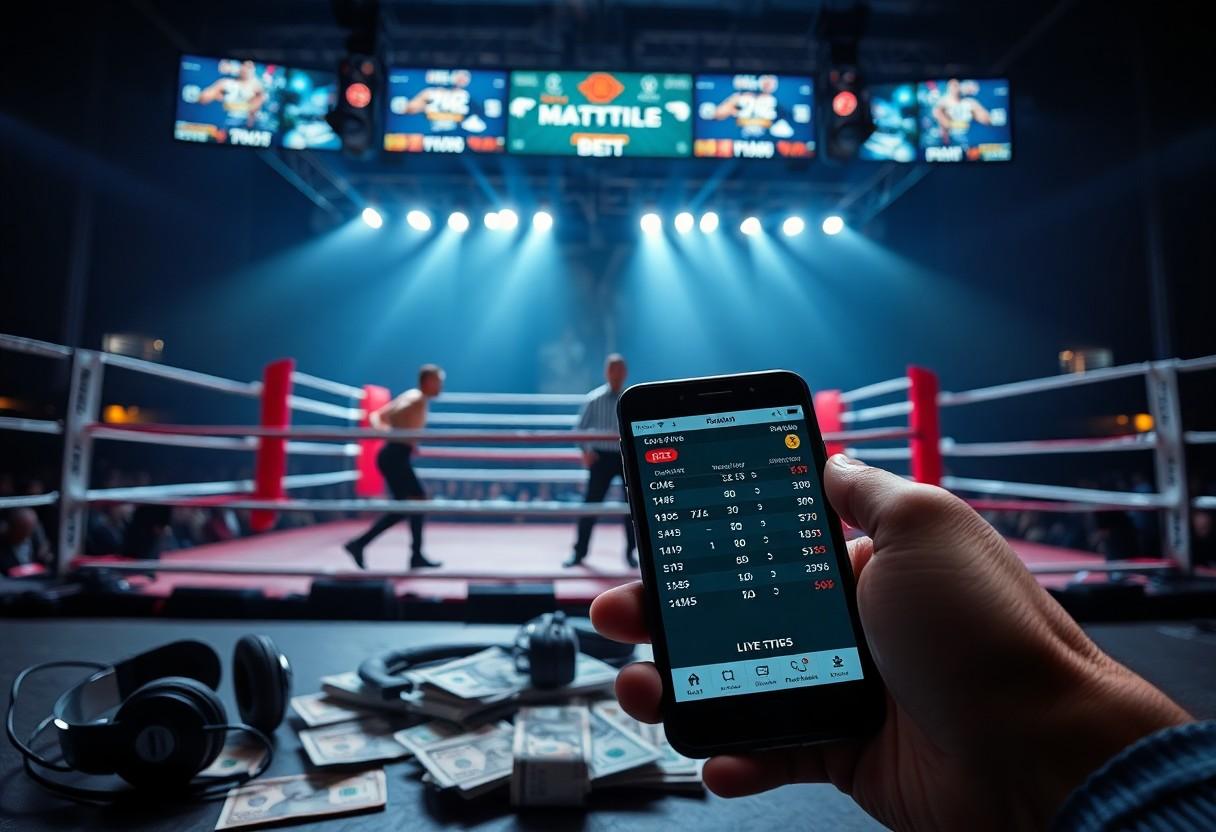
Boxing live betting demands fast analysis and disciplined bankroll control; this guide teaches how to read momentum, exploit shifting odds, and avoid common traps. Focus on momentum shifts, apply strict risk management, use timely cash-outs when value evaporates, and develop templates for corner adjustments, punch stats, and fighter styles to profit across every fight night.
Types of Live Betting on Boxing
- In-Round Betting
- Live Odds Betting
- Prop Bets During Fights
- Round Winner
- Method of Victory
| In-Round Betting | Place wagers on who takes a specific round, whether a round ends by KO, or if a knockdown occurs; these markets have high volatility and can pay between ~2×-8× depending on timing and risk. |
| Live Odds Betting | Back a fighter as prices update continuously; odds can swing 20-60% after a knockdown or visible fatigue, offering frequent hedging and value-spotting opportunities. |
| Prop Bets During Fights | Markets like “first knockdown,” “method of victory,” or round-specific totals; props let you exploit micro-insights such as a fighter’s historical KO rate or punch output. |
| Round Winner | Bet on who wins a listed round; these are short-lived, often higher house edge, and demand rapid decision-making when momentum shifts after visible damage or a point deduction. |
| Method of Victory | Wagers on KO/TKO/Decision outcomes while the fight progresses; extended props pay higher multiples late in fights if a boxer is visibly tiring or seeking a finish. |
In-Round Betting
Short-term markets let you wager on a single round’s outcome-round winner, knockdown occurrence, or round-ending KO. Timing matters: bookies often adjust or suspend these lines within 10-20 seconds of bell, and successful traders watch punch-volume, guard breaks, and corner behavior to find edge within that narrow window.
Live Odds Betting
Odds move continuously based on real-time events; a single clean knockdown can flip a favorite into an underdog in seconds. Professional scalpers use small stakes across many swings, while value bettors look for lines that lag event impact by even a few seconds to capture significant value.
Live Odds Betting
For example, a favorite at -180 might shorten to -350 immediately after a dominant round or lengthen to +120 after a visible cut; tracking implied probability shifts and correlating them with punch stats (CompuBox or broadcast metrics) lets you quantify when the market has overreacted and place corrective bets.
Prop Bets During Fights
Props include first-round KO, whether a fighter scores a knockdown, or total rounds over/under. Sharp bettors exploit stylistic matchups-heavy hitters vs. high-output boxers-and historical rates like a fighter’s KO percentage to size bets where bookmakers misprice situational strengths.
Prop Bets During Fights
Deeper analysis uses context: if a southpaw lands 60% of jabs in round one historically and the orthodox opponent shows slow footwork, the “first knockdown” or “round-specific KO” prop can offer asymmetric payoff; combining live punch-rate data with pre-fight tendencies reveals these mispricings.
The next section breaks down bankroll and hedge tactics tailored to each live-market type.
Key Factors Influencing Live Betting
Momentum shifts, punch output and visible fatigue move lines fast: a single knockdown or a sprained ankle can flip moneyline odds by 20-50% within a round. CompuBox-style punch counts, corner adjustments between rounds, and a fighter’s prior rounds-per-fight trend (e.g., dropping from 45 to 30 punches/round after round six) are especially telling. Judges’ historical favor toward volume or precision matters for late rounds. Knowing these variables lets you size bets and target markets that profit from rapid information edges.
- Fighter Performance
- Fight Style
- Real-Time Events
- Odds Movement
- Venue & Altitude
- Referee/Judging Tendencies
Fighter Performance and Conditioning
Watch early-round output and recovery: a fighter averaging 50+ punches per round over three fights typically maintains pressure through round six, while those dropping below 35 often fade; weight-cut trouble shows as slowed footwork and flattened punches by round three. Recent sparring reports, visible limp or heavy breathing between rounds, and a history of late-round stoppages (e.g., multiple TKO losses after round seven) should adjust live stake sizing toward safer, shorter-term markets.
Fight Style and History
Styles dictate live leverage: a pressure fighter with a short jab routinely forces close exchanges, boosting stoppage chances, while a counterpuncher benefits from overaggressive opponents and late-round point gains. Case study: Ruiz vs. Joshua I saw Ruiz’s compact pressure and timing create a round‑7 TKO, while the rematch showed Joshua’s tactical jab control and distance management reversing momentum; that adaptation pattern is prime for live underdog hedging.
Dig deeper into head-to-head matchups by comparing reach, stance, and past round-by-round scoring; a southpaw vs. orthodox clash typically increases pivoting and lead-hand counters, and a +5-6 inch reach advantage often forces the shorter fighter to accept inside battles where power punching and body work decide outcomes. Use past bout footage to quantify how often the shorter fighter closes distance successfully and whether judges reward aggression or accuracy for late-round betting choices.
Real-Time Events and Changes
Monitor visible injuries, corner instructions, and round pacing: a cut above the eye in round two elevates stoppage risk and shifts live markets toward the healthy boxer; a clear breathing issue or reduced lateral movement signals impending stamina crash. Odds typically react within seconds-expect 30%+ swings after a knockdown-so set alerts for pivotal events to catch value before books fully reprice.
Expand situational awareness by tracking the referee’s tolerance for clinches, the corner’s success at re-energizing a fighter between rounds, and any mid-fight tactic shifts-like moving from inside pressure to outside countering-that historically change expected rounds to stoppage ratios. Markets such as round betting and method-of-victory will reprice faster than moneylines, offering tactical opportunities when you can read the human signals faster than the market.
Step-by-Step Guide to Live Betting
Step-by-Step Breakdown
| Setting Up Your Betting Account |
Open accounts with 2-3 reputable sportsbooks, verify identity to unlock live markets quickly, and fund with amounts that match your plan – e.g., start bankroll $500-$2,000. Configure alerts, set max single-bet limits at 1-3% of bankroll, and test cashout and live odds updates before the card starts. |
| Analyzing Fight Dynamics Live |
Track strike differential, round-by-round pace, and visible fatigue: if a boxer lands >60% power shots in a round or drops an opponent, odds shift fast. Use percentage stats, judge tendencies, and watch corner reactions; early aggression vs late cardio often decides value swings. |
| Placing Your Bets Effectively |
Bet small sizes on live props and line moves, target rounds 2-5 for momentum-based plays, and avoid chasing after a sudden knockdown unless value exceeds implied probability. Use limit orders where available and set exit rules: e.g., cash out at +60% profit or cut losses at -30% of stake. |
Setting Up Your Betting Account
Open accounts with at least two regulated sportsbooks, complete KYC early, and fund with an amount aligned to strategy – typically a bankroll of $500-$2,000 for recreational live bettors. Enable real-time odds, set 1-3% per-bet max, and familiarize yourself with the mobile app’s cashout and prop markets so you can act within seconds when odds swing.
Analyzing Fight Dynamics Live
Focus on measurable metrics: significant strikes landed, clinch time, and round tempo. If a fighter lands >50 significant strikes in R1 while absorbing few, odds will compress; conversely, a jab-heavy fighter winning the first three rounds with low power connects suggests vulnerability late. Use round-by-round trends to spot value against public overreactions.
Watch for specific indicators: a swollen eye, heavy breathing, or a down round where punch output falls by >30% signals declining performance. For example, when a pressure fighter drops output from 45 to 25 punches per round after round four, that often flips late-round prop value toward the fresher boxer. Combine live punch counts with corner behavior and betting market moves to quantify when to switch from standard win bets to round or method props.
Placing Your Bets Effectively
Size stakes relative to live volatility: use smaller units (0.5-1% of bankroll) on volatile in-play props and 1-3% on steadier lines. Target rounds 2-5 for momentum shifts, favoring underdogs only when market odds exceed calculated value – for instance, a +250 underdog after winning R1 cleanly may represent >40% implied value if punch stats support it.
Execute with discipline: set predefined entry and exit thresholds (e.g., enter when implied value >20% above odds, exit at +50-75% profit), use bet limits to prevent tilt, and prefer markets with depth – live round betting or method-of-victory props – where price discovery is slower and you can capture better value without instant market reversal.
Tips for Successful Live Betting
Adapt quickly to in-fight dynamics: prioritize live betting lines that change fastest, stake only 1-2% of your bankroll per bet and cap total exposure at 5% per bout; sportsbooks can swing odds by 20-50% within 10 seconds after a knockdown, so timing beats intuition. Back clear momentum shifts and avoid long-shot chases after big swings, especially when volatile momentum appears. Any disciplined sizing and rapid data use separates winners from impulsive losses.
- Watch momentum – track rounds, punch differential, visible damage.
- Manage bankroll – fixed units, exposure caps, log every bet.
- Use live data – odds feeds, latency alerts, on-site reports.
- Know the fighters – styles, gas tank, and corner tendencies.
Stay Informed and Updated
Follow real-time indicators: punch counts, corner behavior, and live round-by-round stats matter-CompuBox averages and referee stoppage patterns change perception; for example, a fighter losing 25 of 30 punches in a round will often see lines shift 0.5-1.5 points immediately. Combine official stats with ringside tweets and streaming video to spot trends before odds fully adjust.
Manage Your Bankroll Wisely
Adopt a unit system and keep stakes tiny: 1-2% per live wager reduces ruin risk while allowing meaningful profit-if your bankroll is $1,000, a 1% unit is $10 and a 5% max exposure equals $50; that framework prevents chasing after rapid losses and absorbs bad beats.
Implement concrete rules: set a daily loss cap (e.g., 5% of bankroll), log every in-play bet with entry odds and exit reasons, and predefine when to stop trading a fight-if you hit the loss cap or exposure limit, pause. Case study: a disciplined trader who sized at 1% avoided a 30% drawdown during a volatile card that ruined larger, undisciplined bettors.
Use Technology and Tools
Leverage odds-comparison services, latency monitors, and push alerts to beat slow books; markets update in 1-3 seconds on top exchanges, so knowing which app updates fastest is a competitive edge. Employ live-score widgets and low-latency streams to confirm events before committing funds.
Integrate a simple tech stack: an odds aggregator, one fast bookmaker app, and a streaming source with sub-2s latency. Consider automated alerts for line moves >0.3 in decimal odds and a small spreadsheet to calculate implied probabilities on the fly. Traders using this setup often capture value swings others miss, especially around knockdowns and timeout periods.
Pros and Cons of Live Betting on Boxing
| Pros | Cons |
|---|---|
| Exploit momentum swings after knockdowns | Odds can flip within seconds |
| Hedge pre-match exposure mid-fight | Streaming delays (5-30s) create execution risk |
| Target value on round-specific props | Higher vig and tighter limits on in-play markets |
| Use live stats (punch rate, connects) | Emotional, impulsive betting increases losses |
| Opportunity to scalp small edges repeatedly | Latency disadvantages vs sharp traders |
| Can turn small stakes into quick returns | Bookmakers may restrict winners quickly |
| Ability to react to corner tactics and injuries | Mispriced markets due to rushed lines |
Advantages of Live Betting
Active bettors can exploit immediate info-like a sudden cut, a knockdown, or a shift in punch differential-turning pre-fight mispricings into profit; for example, lines often move 20-50% after a clear round swing. Combining live CompuBox-style stats with a disciplined staking plan (1-2% bankroll per live bet or using a fractional Kelly) lets you scalp repeated small edges and hedge pre-match exposure effectively.
Disadvantages and Risks Involved
Fast-moving markets create thin windows to act and streaming delays of 5-30 seconds can make execution fatal to a strategy; odds may adjust by large margins within moments, and many books apply higher vig or quickly lower your limits, so even correct reads can be unprofitable if you can’t get the stake or price you planned.
More risk appears when emotion-driven chasing compounds latency problems: after a bad loss some bettors double down and wipe out weeks of gains. Sharp operators exploit tiny inefficiencies, and casual live bettors often face restricted stakes or account actions after several winning live wagers. Implement strict stop-loss rules, log trades, and test sizing on micro-stakes before scaling to avoid these common traps.
Summing up
Conclusively, “The Ultimate Guide To Live Betting On Boxing – Strategies For Every Fight Night” equips bettors with a systematic framework-pre-fight analysis, in-fight adjustment, bankroll discipline and scenario-based tactics-so they can make informed, disciplined wagers and adapt to momentum shifts, improving long-term edge while managing risk on any fight night.
FAQ
Q: How do I build a live-betting game plan for a boxing match?
A: Start with pre-fight homework: styles matchup, recent form, known stamina limits, and typical round-by-round tendencies. Set clear objectives for the night (small steady profit, specific matchup opportunities, or trade plays). Choose two or three bet types you will use live (moneyline swings, round/round-prop bets, method-of-victory), and decide on a staking plan before the bell. Open accounts at multiple sportsbooks to compare lines and avoid latency issues. During the fight, avoid impulsive large wagers early; use small probes to gauge market responsiveness, then increase size only when you identify a persistent edge (e.g., a fav who cannot close distance, or an underdog whose output is forcing the action). Track the clock and momentum: many live opportunities occur right after a big round, a knockdown, or between rounds when lines adjust to corner reports.
Q: What in-fight indicators should I watch to adjust live bets and spot profitable shifts?
A: Monitor output and effectiveness, not just punches landed. Key indicators: jab control and ring generalship (who dictates distance), power shots vs. volume, visible fatigue (heavy breathing, slower feet), reaction times, corner urgency and instructions, swelling or cuts, and clinch frequency. Watch for pacing changes – a typically slow starter who begins quick could take rounds and force lines to overreact. Use broadcast punch stats and live odds movement as confirmation; rapid line shifts often reflect market recognition of an advantage. Also note fouls or point deductions, which can change the expected outcome quickly. Combine these signals with pre-fight notes (e.g., a fighter who fades late) to size bets when value appears.
Q: How should I manage bankroll and use hedging, cash-outs, and round markets during live boxing?
A: Use percentage-based staking for live action (commonly 1-3% of your bankroll per probe, smaller than pre-match stakes). Apply a fractional Kelly approach if you quantify edges, but avoid overbetting on emotional reads. Predefine stop-loss and profit-target thresholds to prevent chasing. For hedging, calculate how much to stake on the opposite side to lock profit when a large pre-fight position swings in your favor; use partial hedges if you want exposure to a comeback. Cash-outs can be used to secure returns but compare the implied live line to sportsbook odds before accepting. Exploit round and method markets to ladder profits: if a fighter is dominating early, a small bet on specific early-round finishes often offers high odds with limited downside. Always factor in line limits, vig, and potential latency across apps before executing multi-account hedges.