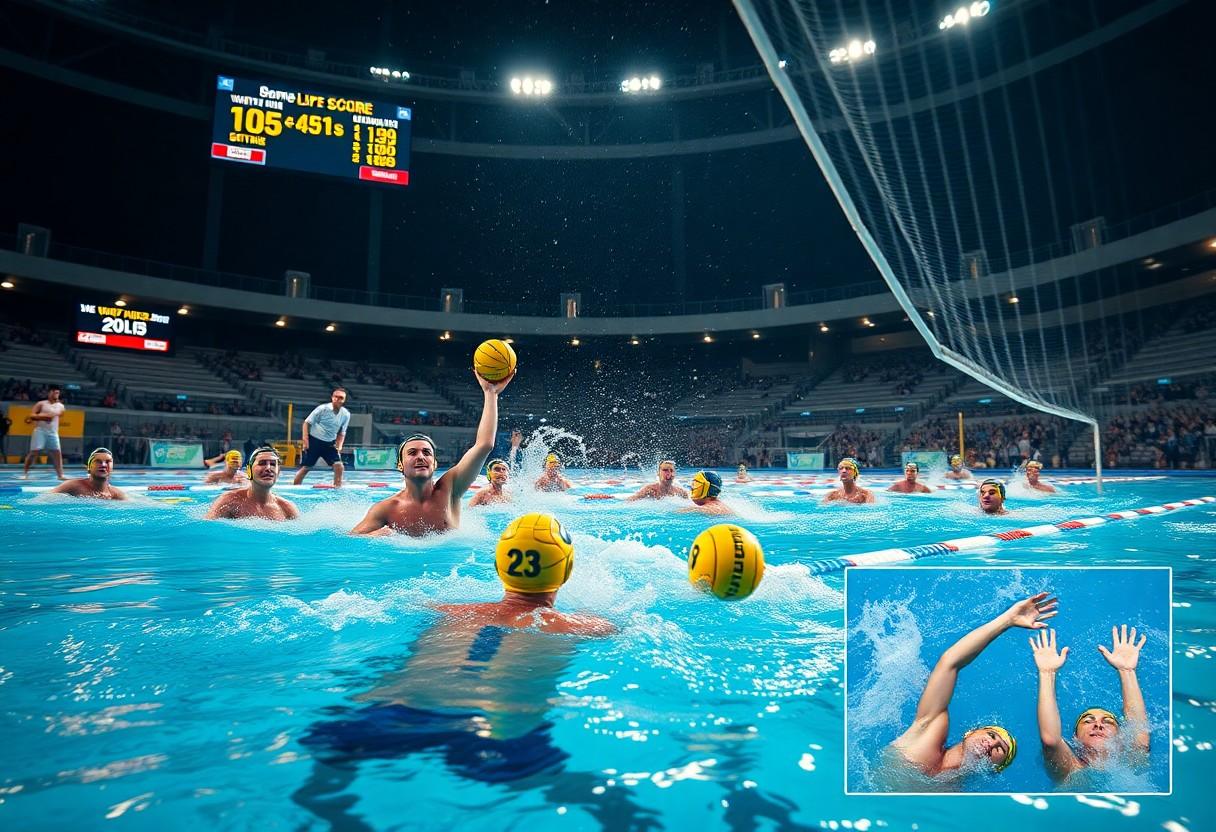

Most successful live bettors in water polo rely on disciplined reading of momentum, watch momentum shifts and red cards/exclusions closely, and fast interpretation of evolving stats; combining pregame research with real-time observation lets you manage your bankroll and stake size while exploiting rapidly changing odds. This guide teaches match-specific strategies, betting timing, risk control, and how to identify value in underdog swings to improve results.
Understanding Live Betting on Water Polo
Live betting reacts to micro-events: exclusions, power plays, quick counterattacks and goalkeeper form can swing odds within seconds. With four 8‑minute quarters and a 30‑second shot clock, markets reprice after each possession; live totals often move 0.5-1.5 goals following a man‑up sequence or a red card, forcing fast staking decisions.
Types of Live Bets
Markets commonly offered in-play include match-winner lines, live handicaps, next-goal markets, totals and player props; each behaves differently under momentum shifts, such as a 2‑goal swing after a rapid double counter. Recognizing network latency, bookmaker limits and market depth is vital for execution.
- Match Winner – odds change with momentum and late exclusions
- Next Goal – resolves in seconds, ideal for counterattack windows
- Total Goals (Over/Under) – repriced after scoring runs or defensive collapses
- Live Handicap – used when one team gains a sustained numerical advantage
- Player Props – penalties, saves or exclusions that emit immediate value swings
| Match Winner | Use when momentum flips after a red card or key exclusion |
| Next Goal | Best during man‑up opportunities or immediate transitions |
| Total Goals | Shift after runs-add 0.5-1 goal when two quick scores occur |
| Live Handicap | Apply when a team leads by 1-2 and controls possessions |
| Player Props | Target when a regular penalty taker is on/off the pool |
Key Factors Influencing Water Polo Matches
Small events determine live outcomes: exclusions per match, man‑up conversion, goalkeeper save rate and bench depth. At elite levels teams average 10-15 exclusions; man‑up conversion can range widely and goalies saving near 50% tilt totals downward. This drives whether you press a totals play, hedge a handicap, or scalp next‑goal lines.
- Exclusions – frequency and timing of man‑up chances
- Man‑up Conversion – conversion rate under pressure
- Goalkeeper Form – saves change expected totals
- Bench Depth – fatigue management into the 4th quarter
Concrete scenarios help: three consecutive man‑up goals typically shift live handicaps by ~0.5-1.0 and increase totals by about +1; a goalkeeper making a penalty save can swing win probability by 10-20% in the following minutes. This tells you when to pursue short‑term scalps versus holding for later value.
- Consecutive Man‑up Goals – often push handicap and totals quickly
- Penalty Saves – immediate momentum and probability swings
- Late‑game Substitutions – indicate fatigue and invite turnovers
- Turnover Chains – create high‑value next‑goal opportunities
Strategies for Successful Live Betting
Step-by-Step Betting Guide
Watch the opening 4-6 minutes to read tempo and goalkeeper form, then place phased bets: small early stakes, increase size only after a confirmed 2-3 goal swing or clear power-play advantage, hedge when odds invert, and set a strict stop-loss (e.g., 5-10% of bankroll). Limit live stakes to 1-2% per opportunity and use quarter breaks to recalibrate based on substitutions, injuries, or line shifts.
Step Checklist
| Trigger | Action |
|---|---|
| Early possession dominance | Small stake on favorite to extend lead |
| Power-play conversion >50% | Bet on expected immediate goal or next-man-up |
| 2-3 goal swing | Hedge or take the underdog value depending on momentum |
| Coach substitutions / injury | Reduce stake size and wait 2-3 minutes for market reaction |
Tips for Making Informed Decisions
Focus on measurable micro-stats: mid-game goalkeeper save rate, power-play conversion, and counterattack success per quarter; teams exceeding 50% man-up efficiency often flip odds quickly. Track market liquidity and rapid line movement as signals of lineup news. Knowing these indicators lets you react before the wider market adjusts and capture value.
- Goalkeeper save %
- Power-play conversion
- Market liquidity
- Counterattacks per quarter
Use live video plus a trusted stats feed to spot fatigue: increased exclusions (>2 per quarter), reduced sprint recoveries, and more long-range shots indicate defensive breakdowns; quantify with simple thresholds (e.g., >3 exclusions → higher man-up danger). Compare current rates to pre-match averages and bench rotation frequency to predict 2-4 goal swings. Knowing substitution patterns, fatigue markers, and bench depth provides clear moments to scale stakes up or down.
- Live video sync
- Exclusion rate
- Substitution patterns
- Bench depth
Evaluating the Pros and Cons of Live Betting
Pros vs Cons of Live Water Polo Betting
| Exploit momentum swings after goals or exclusions | Rapid odds volatility can produce sudden losses |
| Use live stats (man-up time, shot count) to inform bets | Requires instant decisions under pressure |
| Hedge or scale pre-match positions as the game unfolds | Bookmakers widen margins on in-play markets |
| Capitalize on officiating tendencies and specific player form | Limited market depth in lower-tier matches |
| Arbitrage opportunities between different books during swings | Streaming or data latency can make odds unusable |
| Smaller, frequent stakes allow tighter bankroll control | Emotional chasing after big plays increases losses |
| Totals and next-goal markets respond quickly to trends | Quick momentum shifts after a 20s man-up create unpredictability |
| Ability to react to lineup changes or ejections in real time | Account limits or restrictions by bookmakers on successful in-play bettors |
Advantages of Live Betting on Water Polo
Games are played in four 8-minute quarters with frequent 20-second man-up chances, so momentum changes rapidly and bettors can exploit immediate value after exclusions, saves, or substitutions. Using live stats-shot attempts, exclusions, goalkeeper save rate-lets you target high-probability windows, hedge pre-match positions, and size stakes more precisely; professional matches often see combined totals between 12-25 goals, giving many in-play opportunities on totals and next-goal markets.
Potential Drawbacks and Risks
In-play betting exposes you to fast odds swings, wider bookmaker margins, and the danger of chasing losses after dramatic plays; live markets for local leagues often lack liquidity, and streaming delays of 5-15 seconds can turn an apparent edge into a losing bet, so risk management must be tighter than for pre-match wagers.
More specifically, a single 20-second exclusion converted into a goal can shift match-win or next-goal odds by 20-30% within half a minute, and poor latency amplifies that impact. Practical steps: predefine a max liability per match (for example, no more than 2-3% of bankroll on any in-play sequence), use multiple bookmakers to reduce dead-odds risk, monitor live exclusion and shot-clock data closely, and avoid increasing stake size after consecutive losses. These measures mitigate the high-speed volatility unique to water polo in-play betting.
Final Words
On the whole, mastering live betting on water polo demands disciplined bankroll management, rapid tactical assessment of momentum shifts, and close attention to player fatigue and power-play sequences; combining statistical preparation, situational awareness, and disciplined stake sizing will improve long-term results and help you exploit in-play opportunities with confidence.
FAQ
Q: How should I prepare before placing live bets on a water polo match?
A: Do pre-game homework: study both teams’ defensive and offensive styles, recent form, head-to-head trends, and lineups (especially the starting goalkeeper and center forward). Track how often either side concedes exclusions and how efficient they are on the ensuing man-up attack – teams that convert power plays at a high rate change in-play value quickly. Check injury/suspension news and substitution depth; fatigue and bench quality matter late in matches. Have target markets in mind (next-goal, period totals, handicaps) and compare pre-game odds across bookmakers to identify where the live market is likely to move once play starts.
Q: What in-play indicators should I watch to find profitable live bets?
A: Focus on momentum shifts and set-piece events: exclusions (man-up situations), timeouts, and penalty shots create immediate betting opportunities. Watch goalkeeper performance and shot selection – a goalkeeper making several early saves often suppresses total-goals lines. Track the running score and scoring runs; short streaks often present value on next-goal and small handicap markets. Pay attention to period timing: late in a quarter teams take more risk, which can inflate totals. Use live statistics if available (shot attempts, power-play conversion, exclusion count) and line-shop continuously – odds can move faster than your assessment, so take quick, decisive bets when you spot a mismatch between market price and on-pool evidence.
Q: How should I manage bankroll and choose staking for different live water polo bets?
A: Use conservative unit sizing and adapt stake size to confidence and market liquidity: flat-stake units for routine bets, and scaled-up units for high-conviction plays backed by a clear tactical read (e.g., dominant man-up advantage or obvious fatigue). Consider a fraction of the Kelly criterion for value bets to control downside while growing edge. Set loss limits per match and per session to avoid tilt, and avoid chasing losses with larger stakes. Prioritize markets with sharp odds and reasonable turnover (next-goal, period handicaps, totals) and avoid exotic lines with wide spreads unless you have unique information. Log every bet and review outcomes to refine pattern recognition and staking decisions over time.