
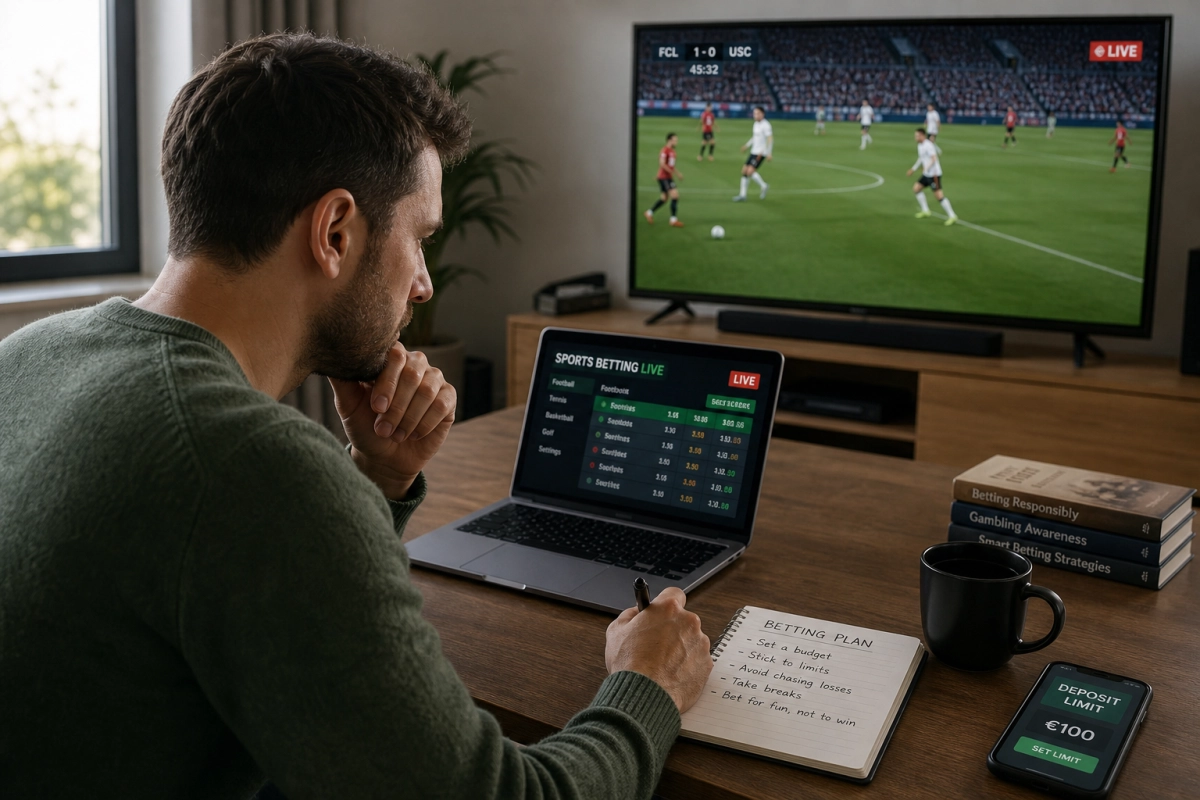
A hands‑on guide to betting responsibly during live matches
Why clear pre‑match rules are the foundation of responsible live betting
Live betting can be fast, exciting and emotionally charged. To bet responsibly during live matches, the bettor needs a set of simple, pre‑match rules that remove guesswork and curb impulse decisions. Pre‑match rules provide a disciplined framework so that changing live odds and momentum do not dictate reckless actions.
Effective pre‑match rules typically include:
- Bankroll limit: a fixed amount dedicated to live betting (separate from other funds).
- Maximum stake per market: a percentage of the live bankroll (commonly 1–5% depending on risk tolerance).
- Daily/session loss cap (stop‑loss): a hard limit that triggers a mandatory pause.
- Market restrictions: pre‑selected markets the bettor will use (e.g., next goal, handicap, quarter markets).
- Time windows: which periods of a match are acceptable for in‑play bets (e.g., first 15 minutes, second half only).
These rules should be written down and easily accessible during live viewing. The aim is not to eliminate risk, but to make risk predictable and manageable as odds change.
Core live‑betting concepts every bettor should understand
What are live odds and in‑play markets?
Live odds reflect real‑time probability estimates updated by bookmakers as events unfold. In‑play markets are betting options available during a match — examples include handicap, totals (over/under), next goal, next point, and time‑specific markets such as quarter or set winners. Odds move quickly after key events (goals, timeouts, injury stoppages); recognising why they move is critical.
Match momentum and live statistics
Match momentum describes which team or player is controlling play. Momentum is informed by live statistics: possession, shots on target, corners, turnovers, serve percentage and break‑point opportunities. For example, in football a sustained spell of pressure with multiple corners will often shorten the odds for a goal; in basketball, a 10–0 scoring run after a timeout similarly shifts market value.
Common market types and simple definitions
- Handicap: an adjusted spread applied to balance a favourite and underdog.
- Totals: wagers on combined points/goals being over or under a set number.
- Next goal/next point: who will score the next goal or point—highly volatile and reactive to live play.
- Cash‑out: a bookmaker option to settle a bet early for a reduced return or smaller loss.
Understanding these concepts helps the bettor interpret price moves and avoid mistakes such as betting only on the scoreline without analysing possession, player fatigue, substitutions or tactical changes.
Having established pre‑match rules and the basic live‑betting vocabulary, the next section will explain how to size stakes in volatile in‑play markets and use cash‑out and stop‑loss tools without surrendering discipline.
Sizing stakes for volatile in‑play markets
Volatility is the defining feature of many in‑play markets — next goal, next point and short time windows can swing odds dramatically in seconds. Your goal is to size stakes so that single volatile outcomes don’t derail your live bankroll or force emotional chasing. Practical rules:
– Define a live‑bankroll unit: choose a fixed percentage of your live bankroll as one unit (common range 0.5–2% for volatile play). Treat that unit as the maximum default stake for any single aggressive in‑play market.
– Tier stakes by market volatility: use smaller fractions for high‑volatility markets. Example: next‑goal/next‑point = 0.25–0.5 unit; short handicaps or totals (e.g., next 10 minutes) = 0.5–1 unit; longer in‑play markets (rest of half/set) = 1–2 units.
– Use fractional Kelly only if you can estimate edge reliably: full Kelly is unstable in live settings. If you calculate an edge, apply 0.25–0.5 Kelly to limit variance.
– Ladder entry sizes after confirming momentum, not before: instead of placing a single large stake, consider incremental bets as events confirm your read (e.g., small stake after pressure, add another if chances increase). Predefine the maximum cumulative exposure for that market.
– Re‑size after wins/losses: update unit size only at set intervals (end of session/day) to prevent increasing risk after a win or chasing after a loss. Never increase stake mid‑match to recoup losses.
Short examples: with a live bankroll of $1,000 and a 1% unit = $10, consider $2.50–$5 for next‑goal lines, $5–$10 for remaining‑half totals, and only $10–$20 for markets where you have a clear edge and longer time horizon.
Using cash‑out and stop‑loss tools wisely, and recognising emotional triggers
Cash‑out and stop‑loss tools are powerful when used as planned, dangerous when used reactively. Treat them as tactical instruments, not emotional safety valves.
Rules for cash‑out:
– Predefine cash‑out thresholds: for example, take a partial cash‑out to secure 50% of projected profit or accept a full cash‑out if it limits a single‑market loss to your pre‑set stop‑loss.
– Use partial cash‑outs to hedge without exiting a position entirely — this preserves upside while locking value.
– Compare cash‑out to expected value: if the offered cash‑out is substantially below the mathematically fair continuation value (if you can estimate it), decline. If it materially reduces downside and keeps you within limits, accept.
– Avoid automatic cash‑outs that you don’t understand; some offers are structured to benefit the bookie when markets are volatile.
Stop‑loss discipline:
– Implement session and per‑market stop‑losses that automatically end your play for the period (e.g., 3–5% of bankroll per session, 10% absolute for a severe run).
– Enforce a mandatory break after a stop‑loss hit (24 hours recommended) to reset judgment.
Recognise impulse triggers:
– Common triggers include: immediate reaction to a late goal/point, attempts to “win back” losses, overconfidence after a streak, fatigue, alcohol, or crowd excitement.
– If you feel an urgent need to bet after a trigger, apply a cooling mechanism: 10–30 minute pause, write the intended bet and reason, review pre‑match rules — only proceed if it matches your plan.
Sport‑specific live‑betting checklists: football, basketball and tennis
Use short, repeatable checklists tailored to each sport to convert observation into disciplined action.
Football
– Key live stats to watch: shots on target, corners, expected goals (xG) momentum, possession, substitutions, bookings, injury stoppages.
– Markets to prefer: remainder of half/second‑half totals, value on late handicaps when pressure is sustained.
– Avoid: next‑goal unless you have clear evidence (sustained corners/chances); don’t chase immediately after a concession.
Basketball
– Key live stats: scoring run length, foul trouble, rotations/bench minutes, timeouts, pace (possessions per minute).
– Markets to prefer: quarter/half spreads, team total lines when starters/bench mix changes.
– Avoid: micro‑bets on single possessions unless you track rotations and matchup advantages.
Tennis
– Key live stats: serve percentages, unforced errors, break‑point conversions, medical/time‑out incidents, court surface effects.
– Markets to prefer: set handicaps and match totals after the first service games; selectively use next‑game markets when a server is consistently broken.
– Avoid: instant next‑point bets on returners without clear evidence (serve speed/second‑serve weakness).
Keep each checklist visible during viewing, tick items off before staking, and update them with notes in your betting journal to refine your approach over time.
A short practice plan to build disciplined live‑betting habits
Turn the concepts into routine through a focused, low‑risk trial. Use the plan below for your first week of disciplined live betting and adjust based on what you learn.
- Session 1–2: Observe only. Watch matches using your sport checklist, note momentum signals and price moves without staking money.
- Session 3–4: Small‑stakes practice. Apply written pre‑match rules, limit unit size to the low end (0.5–1% of live bankroll) and place no more than 2–3 in‑play bets per session.
- Session 5–6: Controlled execution. Introduce ladder entries and one predefined partial cash‑out rule. Keep a short journal entry for each bet (reason, stake, outcome, emotion).
- Session 7: Review and reset. Evaluate your journal, check adherence to stop‑loss limits, and revise rules where patterns of error appear. If you hit a stop‑loss, enforce a mandatory cooling period before continuing.
A final word on control and learning
Responsible live betting is less about finding a perfect system and more about cultivating habits that protect your bankroll and your judgment. Treat each session as practice: aim to learn from small, controlled experiments rather than trying to win big quickly.
Keep your rules visible, your stakes conservative, and your emotions checked. When uncertainty or strong impulses arise, default to the simplest protective action — pause, review your written rules, and walk away if necessary. If gambling begins to cause stress, financial strain or compulsive behaviour, seek professional help and consider self‑exclusion tools provided by operators.
Betting on live sport can remain an enjoyable way to engage with events if you prioritise control, learning and boundaries. Build slowly, record honestly, and let steady discipline be the engine of long‑term improvement.