How to build in-play bankroll limits and stake-sizing rules for responsible live betting
Responsible live betting requires a clear, pre-planned system for how much to risk and when to stop. This guide explains simple, enforceable bankroll limits, stake-sizing methods, stop-loss and cash-out thresholds, and the quick-decision rules bettors need during fast-moving matches. It defines key terms like live odds, in-play markets, cash out and match momentum before showing practical examples for football, basketball and tennis.
Core concepts: live odds, in-play markets and basic risk controls
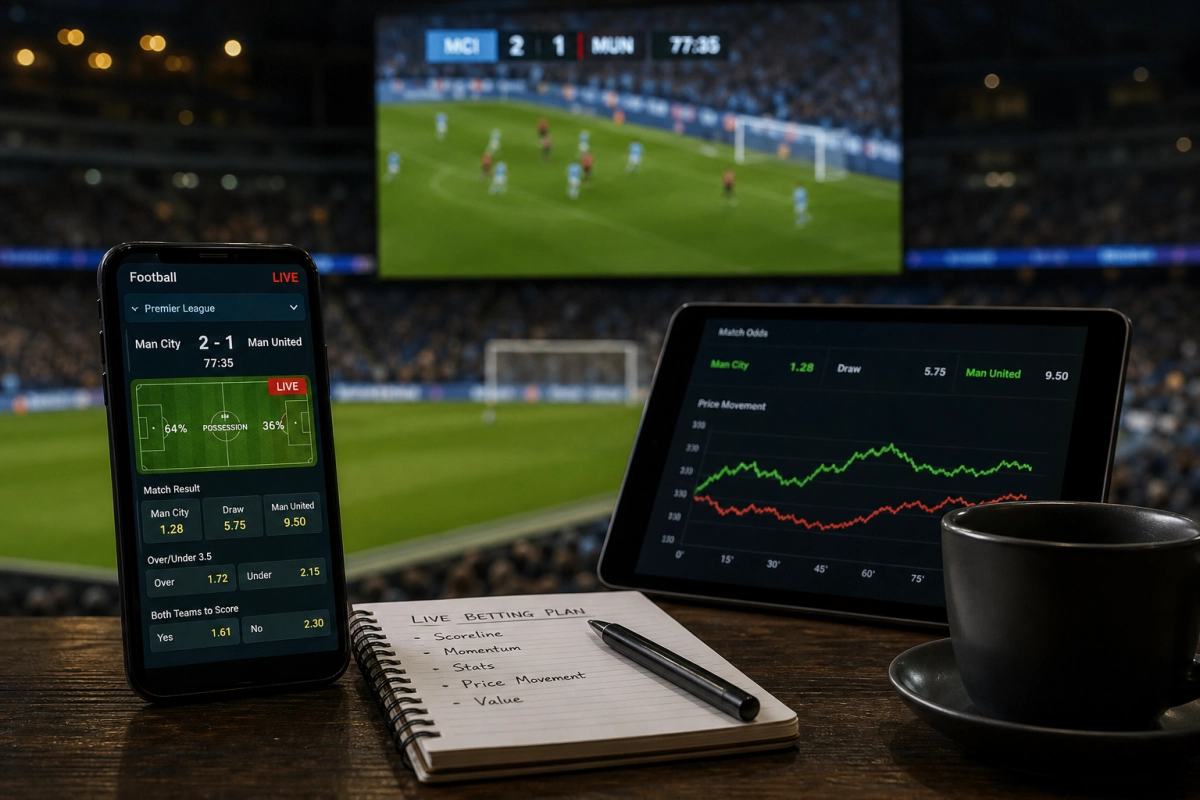
Live odds: bookmaker prices that change continuously during a match to reflect events, momentum and market bets. In-play markets: next goal/point, match winner, handicaps and quarter/set markets offered while the event is ongoing. Cash out: a bookmaker offer to settle a position early for a smaller profit or reduced loss.
Before placing any in-play wager a bettor should decide three baseline controls:
- Bankroll: total money allocated for live betting separate from other funds.
- Unit size: a fixed fraction of bankroll used as the basic stake.
- Session stop-loss and profit-target: limits that end betting for the current match or session.
How to choose an in-play unit and maintain stake discipline
A practical rule is to use a smaller unit for live bets than for pre-match bets because decisions must be faster and volatility is higher. Common guidance (not a certainty of success) is:
- Conservative: 0.25%–0.5% of bankroll per live unit.
- Balanced: 0.5%–1.0% per live unit.
- Aggressive: up to 2% per live unit (high risk, not recommended for most bettors).
Example: with a $1,000 live bankroll, a balanced unit of 0.5% equals $5. A single in-play bet might be 1–3 units depending on confidence and the market; never exceed a pre-set per-bet cap (for example 3 units).
Pre-set stop-loss, cash-out thresholds and simple enforcement rules
Pre-defining exit rules removes emotional reaction during a match. Use both loss-limits and profit-preservation rules:
- Session stop-loss: stop live betting for the session if losses reach 3%–5% of bankroll.
- Per-event max loss: cap losses on one match to 2%–4% of bankroll.
- Cash-out thresholds: consider taking a cash-out if a bet reaches a pre-set profit (e.g., 30%–50% of potential return) or if match conditions rapidly reverse.
Enforcement tips: set automated alerts, place maximum stake settings with the bookmaker when possible, and log every live bet to review post-session. Emphasise responsible live betting and never chase losses—if a stop-loss is triggered, close the app and reassess later.
With these foundational rules—defined unit size, session and per-event stop-losses, and clear cash-out criteria—bettors reduce impulsive risk and create repeatable behaviours. The next section provides fast-decision checklists and sport-specific rapid-response examples for football, basketball and tennis to apply these rules in real time.
Fast-decision checklists for live betting
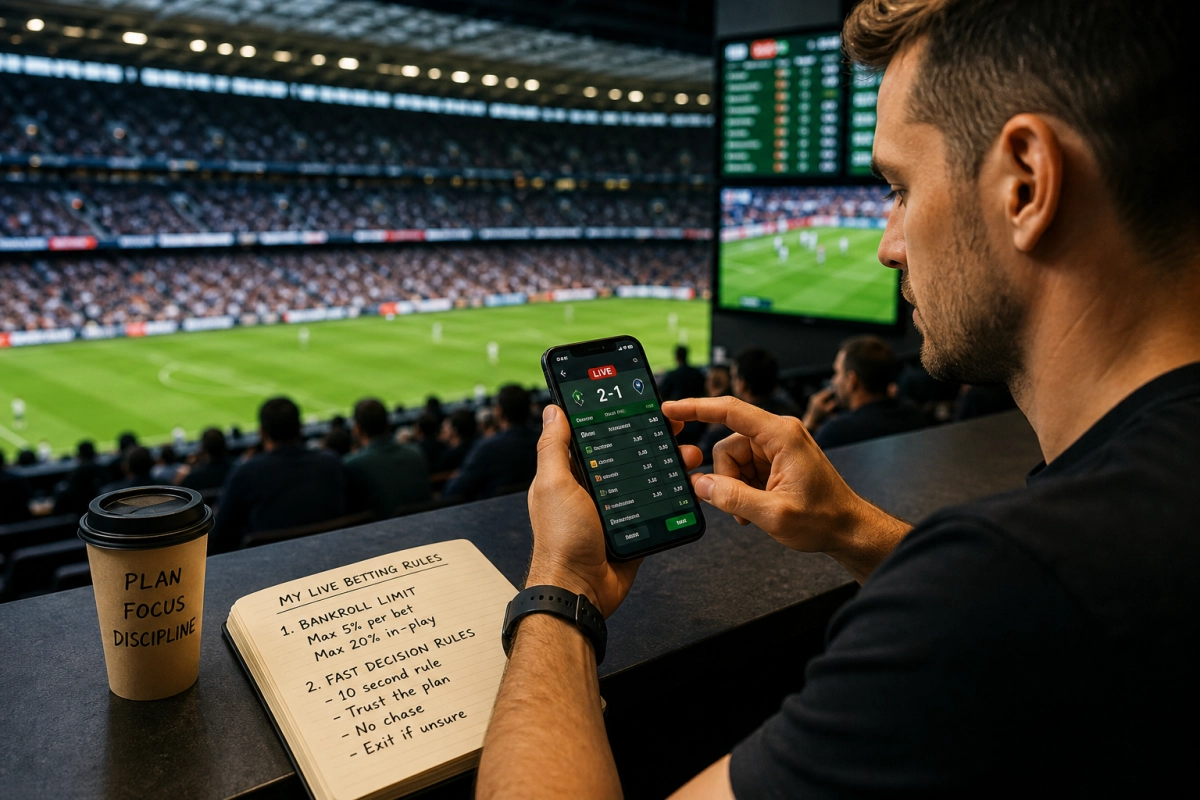
When a match moves quickly you need a short, repeatable checklist you can run through in seconds. Memorise a 6–8 item micro-checklist and enforce it with a hard time cap (decide in X seconds or skip):
- Time cap: set an upper limit for decision-making (possession/point markets: 3–8s; larger market shifts: 8–15s). If you exceed it, do not bet.
- Unit confirmation: state your unit size aloud or in your head (e.g., “0.5u”) and cap the bet (max per-bet = 3u unless pre-approved).
- Trigger validation: identify the exact trigger (red card, timeout, break point, momentum run) and that it matches one of your pre-defined patterns.
- Edge check: is there a clear edge? (Bookmaker odds vs expected probability, recent form, obvious event-driven advantage.) If no edge, skip.
- Stop-loss check: confirm the per-event and session stop-loss won’t be breached if this bet loses.
- Cash-out rule: decide pre-bet the cash-out threshold (take profit at +30–50% of potential return, or cut losses at -40–60% of stake) or commit to no cash-out when odds are favourable.
- Record decision: make a one-line note (time, market, stake, rationale) immediately for later review.
- Emotional check: if you feel tilted or chasing, enforce a cool-down pause and skip.
Practical enforcement: set your phone/tablet screen timer for the time cap, use the bookmaker’s stake presets, and keep a simple running log (notebook or notes app) with one-line entries. Rehearse the checklist so it becomes automatic.
Sport-specific rapid-response examples: football, basketball and tennis
Below are compact, actionable templates you can apply in-play. Each gives a trigger, stake guidance (relative to a balanced 0.5% live unit), stop-loss and cash-out approach.
Football (soccer) — next goal / match-winner
- Trigger: favoured team concedes a soft goal but immediately dominates territory (e.g., forced corner within 2 minutes).
- Action: back favoured team to score next — 0.5u for standard confidence, 1u if clear numerical advantage (red card for opponent).
- Stop-loss: if the live position turns to -1.5u total on the match, close out and pause betting on the match (per-event cap: 2% bankroll).
- Cash-out: consider cashing out when profit >40% of potential return and resumption of balanced play is likely; avoid cash-out if cash-out value is very small relative to expected hold.
Basketball — next possession / quarter markets
- Trigger: 7–0 run by one team or timeout called; possession bets require near-instant decisions.
- Action: for very short windows (next possession), use 0.25–0.5u; for quarter/line corrections after timeout, 0.5–1u depending on roster news (star substituted).
- Stop-loss: impose a tighter per-event cap (1%–2% bankroll) because swings are fast; if losses hit per-event cap, stop on that match.
- Cash-out: favour taking moderate profits quickly in volatile runs (take profit at +30%–40%) rather than letting swings reverse.
Tennis — games and break-point situations
- Trigger: server under pressure on break point, visible fatigue, or double-fault pattern.
- Action: back returner for the break with 0.5u if odds reflect >expected probability after the trigger; raise to 1–1.5u only when match momentum and statistics strongly favour a turnaround.
- Stop-loss: per-event loss cap 1%–2% of bankroll; if several bets in a match lose, stop after cumulative loss reaches session stop-loss.
- Cash-out: use sparingly—most cash-outs in tennis are unfavourable; prefer pre-defined profit targets (e.g., close at +40%) or accept full exposure until a clear match-closing situation.
Use these templates as starting points—calibrate unit sizes and thresholds to your own bankroll, trading style and betting edge. The goal is fast, consistent choices that align with your predefined risk controls rather than impulsive reactions to every swing.
Practice, enforcement and continual improvement
Rules only work if they are practiced and enforced. Treat your in-play system as a living process: rehearse it, test it under low stakes, and make small, evidence-driven adjustments rather than impulsive changes.
Record keeping
- Log every live bet with one line: timestamp, market, stake (units), rationale, outcome. Review weekly to spot patterns and leaks.
- Track emotional state and decision time alongside results to identify when speed or tilt degrades performance.
Automation and practical enforcement
- Use bookmaker stake presets, session limits and app timers to enforce unit sizes and time caps.
- Set phone alerts or calendar blocks to enforce cool-down periods after triggers (e.g., 30–60 minutes after a session stop-loss).
- Consider third-party tools for notifications and simple logging if your bookie’s tools are limited.
Accountability and scaling
- Share your rules with an accountability partner or community; external checks reduce the risk of rule-breaking during stress.
- Scale units only after a sustained, objective period of profitable, rule-following performance (for example, after 50 logged sessions with consistent adherence).
Final guidance for responsible in-play betting
Keep your system simple, enforceable and aligned with your temperament. Prioritise discipline over short-term gains: rehearse the micro-checklist until decisions are automatic, protect your bankroll with hard stop-losses, and stop betting when rules or emotions break. Responsible live betting is not about winning every swing but about making quick, repeatable choices that preserve capital and clarity of mind.