
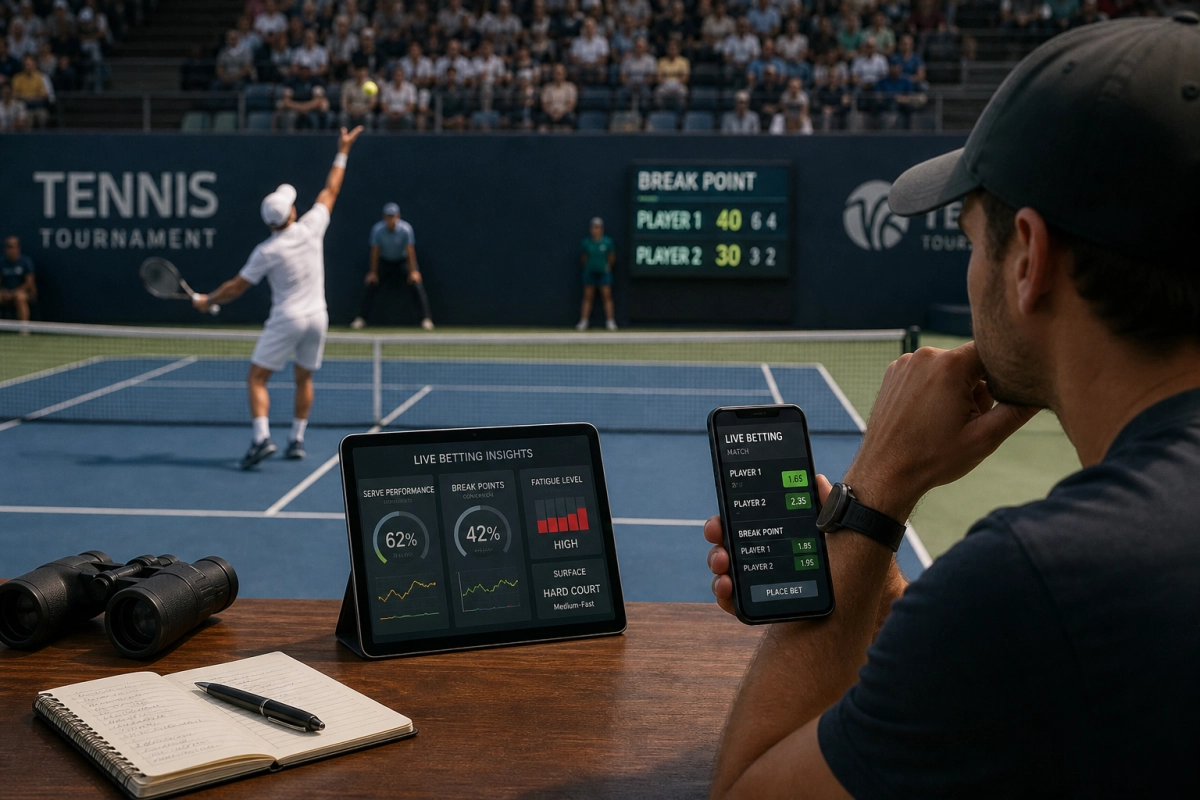
Reading match signals for smarter tennis live betting
This guide explains how to read serve and return performance, break-point leverage, set patterns, player fatigue and court-surface effects during a match so bettors can choose the best live markets (next point/game/set, match winner, handicaps, totals) and manage stakes responsibly. The instructions are practical for beginners and contain tactical depth for experienced bettors interested in tennis live betting.
Core live-betting concepts every bettor should know
What are live odds and in-play markets?
Live odds update continuously to reflect current match state, recent actions and market flow. Common in-play markets in tennis include:
- Next point / next game — short-term markets requiring fast reads.
- Set winner / match winner — medium-term bets that reflect momentum and endurance.
- Handicaps (games/sets) — used to balance mismatches.
- Totals (games, sets) — predictable when players trade holds or breaks.
- Cash out — early exit option; useful but often offers reduced value.
Key terminology explained
- Match momentum: a sequence of points/games that shifts probability in one player’s favour.
- Break-point leverage: how pivotal a break point is based on score and serve — breaking at 3–3 is often higher leverage than at 0–5.
- Serve/return performance: first-serve percentage, second-serve effectiveness and return winners/pressure.
- Fatigue: observable drops in speed, footwork or service power, often after long rallies or consecutive long sets.
Early-match reads: serve, return and break-point leverage
Step 1 — Quickly assess serve reliability
Within the first two service games, track first-serve percentage, free points (aces/unreturned serves) and double faults. A player hitting 70%+ first serves and producing several free points is a strong hold candidate; odds for the opponent to win that next service game will be longer.
Step 2 — Observe return aggression and patterns
Some returners attack the first serve; others wait for second serves. Early patterns reveal whether returning player can consistently force short points or create break opportunities. If the returner wins most points on the opponent’s second serve, live markets for “break next game” or “player to win next game on opponent’s serve” become more attractive.
Step 3 — Evaluate break-point leverage, not just count
All break points are not equal. Consider:
- Score context — break at 4–4 is higher leverage than at 1–4.
- Server comfort — some players elevate on pressure while others fold.
- Surface influence — slow clay increases return chances; fast grass benefits strong servers, lowering break expectancy.
Example: if a player faces three break points at 3–3 on clay after several long rallies, the market should lengthen the server’s next-game odds; if it doesn’t, there may be value on the returner.
Risk control from the outset
Set a pre-match stake limit and a per-market cap for in-play wagers. Live betting is fast; a simple rule (e.g., max 2–5% of bankroll per live bet) preserves capital and prevents emotional chasing. Avoid increasing stakes just because odds appear “too good” without confirming tactical or physical evidence on court.
Next, the guide will break down mid-match indicators — set patterns, fatigue signals and court-surface shifts — and show how to map them onto specific live markets like handicaps and totals.
Mid-match patterns: reading set rhythm and choosing set/handicap markets
Once a set is underway, look for structural patterns rather than isolated points. These patterns dictate whether you target the next set, set handicaps or totals:
- Consistent holds with few breaks — the set is likely to go long. Markets to consider: set totals (over games), tie-break occurrence, and small handicaps (±1.5 games) instead of outright set winners.
- Early break(s) followed by conservative serving — the breaker will often lock down. Consider betting the breaker for the set, or the server-at-penalty in a small handicap. Odds often underreact to a timely break; value exists when the market still prices the server as favourite to hold next game.
- Patterns of mini-breaks (exchange of one break each) — suggests volatility and higher game totals. Tradeable markets: next-game overs, game totals, or betting the stronger returner on the opponent’s serve when momentum swings.
- Dominant server who still loses long rallies — if the server produces many free points but concedes extended rallies on return, expect compressed games with occasional long games. Small handicaps on the server and under on game totals can both be viable depending on which effect dominates.
Example: in set two a player who won set one 6–3 breaks early and then serves narrowly for five straight games (many deuces). The set is trending to fewer total games — a live bet on that player to win the set, or a -1.5 game handicap when available, will often be the higher-expected-value play.
Fatigue and momentum swings: targeting match-winner and live handicap opportunities
Fatigue shows up predictably: falling first-serve percentage, slower footwork, longer recovery between points, more unforced errors, and decreased serve speed. Use these signals to shift from short-term bets to match-level markets.
- First-serve drop of ≥10 percentage points across successive service games is a red flag — increases break probability and suggests betting the opponent on match-winner or against the tired player in handicaps.
- Repeatedly lost service games in late stages after long rallies/sets — shift to betting the fresher player for match-win or take an in-play plus-games handicap on the trailing, tired player.
- Mental signs (double faults under pressure, slow body language, more net errors) often precede a decisive collapse. Markets: match-winner, and next-set handicaps if the tired player just lost a long set.
Staking note: scale stakes by clarity of evidence. If you observe one fatigue signal, reduce stake; multiple corroborating signals (serve drop, visible slow movement, and recent lost games) justify larger but still capped live stakes. Example: after 2h10m on clay, Player A’s first-serve % falls from 68 to 52 and they lose serve twice — a bet on Player B for match-winner or +3.5 games handicap for B is a logical, stake-weighted move.
Surface and in-match conditions: recalibrating totals and point markets
Surface and evolving court/weather conditions change point construction during a match. Re-assess markets when these factors shift.
- Ball wear and court pace: balls get heavier and slower; previously fast surfaces may produce longer rallies late — favour game/total overs and bets on returners.
- Wind and sun: increased errors and shorter rallies when wind picks up; next-point markets (errors/return winner) and under on game totals can be profitable short-term plays.
- Day-to-night transitions: many hard-court venues slow after sunset — expect fewer aces and more breaks; amend market selection toward match-winner/handicap on the returner and over on set totals if servers start to struggle.
Example: on a grass match, the baseline wears and rallies lengthen after an hour. If aces drop and rally lengths rise, pivot from next-point serve-heavy markets to totals and returner-focused next-game markets where value emerges.
How to build a simple in-play routine
Turn the concepts above into a compact, repeatable routine you can use during matches. Keep it intentionally short so you can act quickly without losing clarity.
- Pre-match: set bankroll caps, identify likely live markets (next game, match-winner, handicaps) and note surface/time-of-day influences.
- First two service games: check first-serve% and free points; observe whether the returner attacks first or second serves.
- Mid-set: mark any structural patterns (holds-only, early-break lock-down, mini-break swaps) and decide whether to target set totals, tie-break, or small handicaps.
- Late match: watch for fatigue signals (serve% drop, slower movement, obvious timing issues) and shift toward match-winner or opponent handicap markets when multiple signals align.
- Environmental checks: reassess after any clear change (ball wear, wind, lighting). Adjust market focus from serve-heavy short bets to totals/returner bets as conditions change.
- Post-bet discipline: stick to stake caps, log rationale and outcome, and avoid chasing losses within the same match.
Putting it into action
Treat live tennis betting as a disciplined information game: collect quick, reliable signals; map them to the markets that best reflect the evolving edge; and manage stakes so one mistake won’t derail your bankroll. Progress comes from consistent application, honest record-keeping and resisting the urge to bet on emotion or gut alone. Use the routines above to make decisions faster and smarter, and let the court — not the noise of the market — guide your choices.