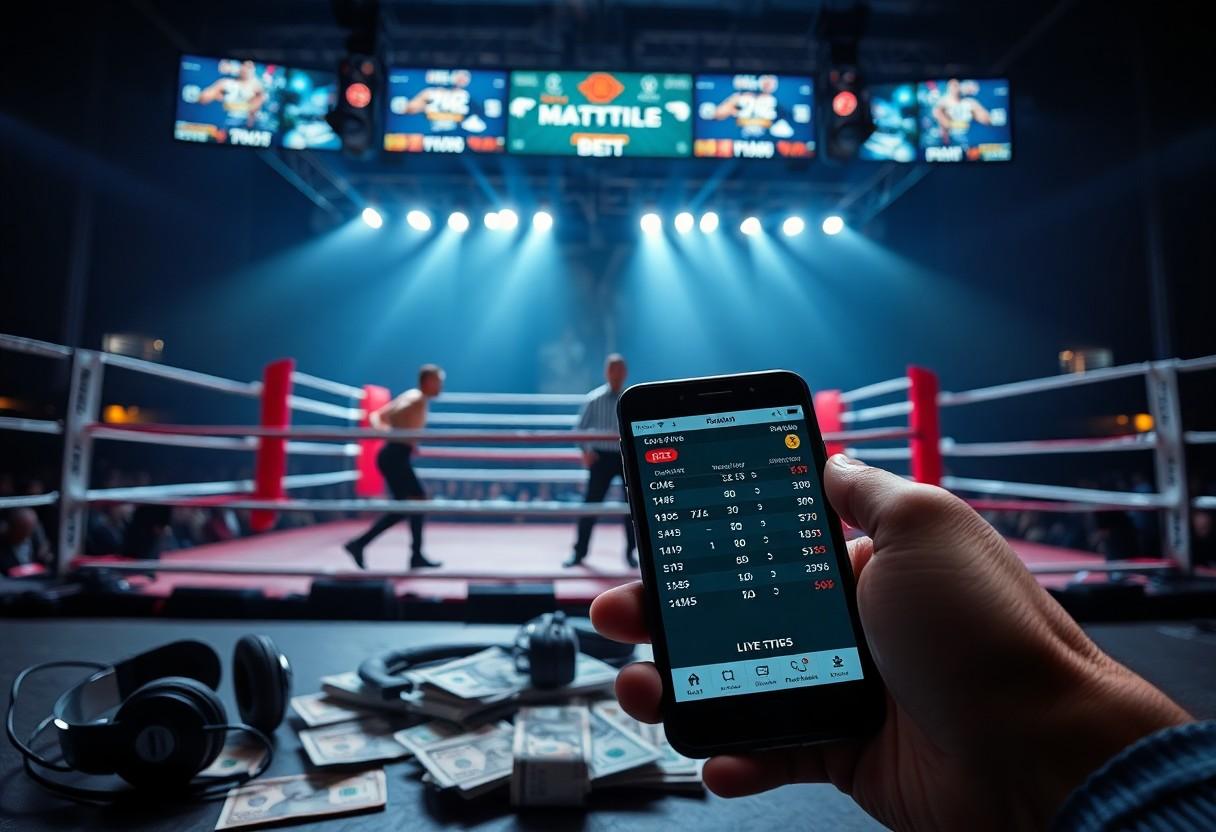
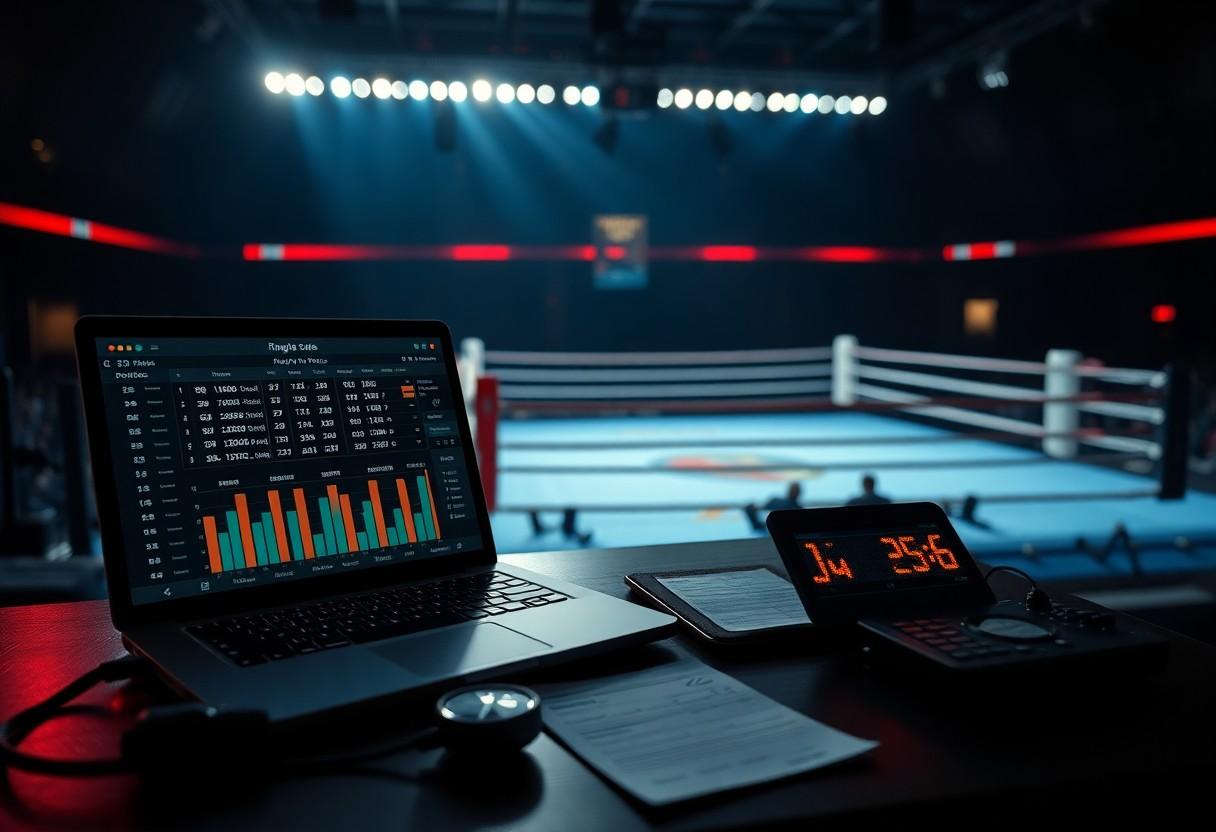
Most live bettors succeed by tracking a short list of metrics that reveal fight momentum and risk: punch output and connect percentage to gauge offense, damage absorbed and susceptibility to body shots to spot danger, and ring control, clinch rate and late-round stamina to forecast comebacks; combine these with corner activity and visible weight-cut distress to make informed in-play wagers.
Types of Boxing Statistics
| Offensive Statistics | Tracks punches thrown/landed, accuracy and power; CompuBox measures these as thrown vs landed and helps identify fighters averaging 40-70 punches per round or 25-50% accuracy. |
| Defensive Statistics | Measures punches absorbed, block/slip rates and footwork efficiency; elite defenders often allow <10 landed punches per round versus higher-pace fighters at 20-35. |
| Activity / Output | Punches per round and work rate-useful for over/under rounds and momentum shifts; abrupt drops signal fatigue or injury. |
| Accuracy | Overall and jab/power split; a fighter landing >40% of power shots is far likelier to change in-play odds than one at 20%. |
| Power / KO Rate | KO% and heavy-shot landing rate; fighters with a career KO% >50% force different live-line moves when rounds go late. |
- Offensive Statistics
- Defensive Statistics
- Activity / Output
- Accuracy
- Power / KO Rate
Offensive Statistics
Punch volume, strike location and conversion rates tell you who controls tempo: CompuBox shows typical pros throw 40-70 punches per round while elite volume fighters can exceed 70. Analyze jab-to-power ratios, noting a fighter landing >30% of power shots often forces opponent adjustments; early-round spikes in output (e.g., 50+ landed in rounds 1-3) predict momentum shifts useful for live round betting.
Defensive Statistics
Blocked, slipped and absorbed punches quantify vulnerability: top defenders block or avoid a large share, keeping absorbed punches below 10 per round, whereas high-absorption styles allow 20-35. Track sudden rises in absorbed punches and drops in block rate to identify openings for late-round swings.
Detailed film study combined with CompuBox trends reveals practical patterns-for example, a fighter whose block rate falls from ~60% to ~40% after round six while absorbed punches climb from 8 to 18 per round typically shows fatigue or damage; adjust live stakes toward the fresher boxer. The pattern of rising absorbed punches after round six is a red flag for live traders.
Key Factors to Consider for Live Betting
Track in-fight metrics like punch output, connect percentage, and ring control: fighters averaging >40 punches per round with a >35% connect rate typically dictate tempo, while a KO rate above 50% signals one-shot danger; watch visible damage and corner behavior for stamina clues. Perceiving subtle declines in output often points to impending momentum shifts.
- Punch output (throws/lands per round)
- Connect percentage (CompuBox or live counts)
- Ring control (center time, cageing)
- KO rate (career knockout percentage)
- Injury/visible damage (cuts, swelling, limps)
- Corner signals (tactical changes, urgency)
- Odds movement (market steam, line drift)
Fighter’s Historical Performance
Analyze the last 12-24 months: a fighter with a 70% KO rate who averages 8.5 rounds per bout shows different risk-reward than someone surviving deep with low output; check outcomes vs. similar styles-pressure fighters vs. counterpunchers, orthodox vs. southpaw-and integrate CompuBox splits and opponent quality to quantify matchup edges.
Current Form and Fitness Level
Evaluate recent activity, weight-cut behavior, and sparring reports: fighters who rehydrate >10 lbs often lose early mobility, while visible breathlessness or slowed footwork in rounds 1-3 signals poor conditioning; monitor jab frequency and reaction time as live proxies for fitness.
Drill deeper by tracking round-to-round metrics: a drop from ~42 to ~28 punches thrown by round three is a red flag, and a connect-rate fall from ~38% to ~22% indicates guard breakdown. Cross-check with weigh-in gains, recent medical notes, and gym video for shoulder/knee limitations; if a corner repeatedly yells “move” or “box,” expect tactical tightening or damage control that affects late-round value.
Tips for Effective Live Betting
Prioritize real-time indicators: punch output, connect rate, ring control, and stamina trends versus pre-fight models. Use live boxing statistics (punches landed per round, defensive efficiency) and watch odds movement for market sentiment shifts. React when a fighter posts a sustained 2:1 volume advantage-e.g., 60 total punches vs 30-and avoid emotional chasing. Assume that you should size bets smaller after the first two rounds while volatility is highest.
- live betting – monitor odds and latency to exploit short windows
- boxing statistics – track punch differential and connect percentage
- fight dynamics – note pace, distance control, and corner behavior
- in-round performance – watch knockdowns, staggered legs, and clinch time
- odds movement – compare market shifts to observed events for value
Analyzing Fight Dynamics
Dissect range, tempo, and damage accumulation every round: sustained body work or a 2:1 punch-volume advantage (e.g., 60 vs 30) signals control. Cross-check visible fatigue-heavy breathing, lowered hands-and corner adjustments against pre-fight form. Use fight dynamics to decide if a fighter’s early dominance will convert to later rounds, and let live betting odds drift before committing larger stakes.
Adjusting Bets Based on In-Round Performance
Scale bets when in-round metrics shift: heavy connected shots, a knockdown, or a drop in output from a fighter should trigger stake reductions of roughly 30-50% until the round settles. Monitor in-round performance like connect rate and staggered exchanges, and exploit rapid market overreactions within 20-30 seconds for small, high-value trades in live betting.
Practical example: a flash knockdown in round 3 can shorten a favorite by 20-40% within 10 seconds; placing a small hedge or a counter-prop (round finish) in that window often yields value. Apply time rules-avoid full-size bets for the first 15 seconds after a knockdown-and keep live stake limits to 1-2% of bankroll per trade while using real-time boxing statistics to minimize drawdowns.
A Step-by-Step Approach to Tracking Statistics
Step-by-Step Checklist
| Step | Action & Example |
| Pre-fight scouting | Log reach, stance, age, last 3 opponents, and KO% (e.g., Fighter A – 72% KO, 6’1″ reach). |
| Establish baselines | Record jabs/round, power punches/round, and connect% (typical: 3.2 jabs/round, 42% power connect). |
| Weigh & travel checks | Note weigh-in vs limit; >2 lb miss and long travel are danger signals. |
| Round-by-round logging | Track per-round punch counts, accuracy, and fatigue (accuracy drop from 48% → 30% after R6 is notable). |
| Live market response | Monitor odds movement and set cashout/hedge thresholds (e.g., shorten/lengthen >30% triggers action). |
Pre-Fight Preparation
Scan the past 12 months for sample size: log reach, stance, age, and per-round stats like jabs/round and power connects; for instance, a fighter averaging 3.2 jabs/round but conceding 5.6 jabs is at a tactical disadvantage. Flag an opponent with a >50% KO rate and any weigh-in >2 lb over limit as high-risk betting conditions.
In-Fight Monitoring Techniques
Follow punch differential each round and cumulative totals-an underdog outlanding a favorite by >20 after four rounds often forces line shifts. Track connect% trends (e.g., 48% → 30% signals fatigue), clinch time, and referee intervention; update staking plans when live CompuBox-style counts confirm momentum change.
Use concrete live triggers: hedge if your pick trails by >10 landed punches after R1, or raise exposure when power connect exceeds 50% across consecutive rounds. Also log visible cuts and referee warnings immediately-both can swing odds sharply and validate in-play adjustments.
Pros and Cons of Different Betting Strategies
Strategies like flat staking, Kelly, Martingale, arbitrage and live value plays each trade risk for return: flat betting (1-3% of bankroll) limits variance, Kelly maximizes growth but raises drawdowns, and Martingale can produce quick losses that wipe accounts. Arbitrage typically yields small, steady returns of 1-3% per event, while live betting offers edges from fluctuating lines but demands speed and discipline. The table below breaks specific upsides and downsides down further.
| Pros | Cons |
|---|---|
| Stable variance with flat staking (1-3% stakes). | Slow bankroll growth; needs large sample size to profit. |
| Kelly maximizes long‑term growth if edge estimates are accurate. | Higher drawdowns and sensitivity to bad edge estimates. |
| Martingale can recover small losses quickly in short runs. | Fast bankroll ruin from streaks; requires huge bankroll. |
| Value betting targets mispriced lines for positive EV. | Requires strong modeling and line access; edges often small. |
| Arbitrage locks risk‑free profit across books. | Margins tiny (1-3%); subject to account limits and detection. |
| Betting favorites offers higher hit rate at lower odds (e.g., -150 ≈ 60% implied). | Low returns per bet; losses still possible due to vig and upsets. |
| Betting underdogs yields larger payouts and occasional big swings. | Lower strike rate; needs strict bank management for variance. |
| Live betting exploits line movement and in‑fight info. | Demands speed, discipline and good connectivity; emotional errors are common. |
Betting on Favorites vs. Underdogs
Favorites at lines like -150 imply ~60% probability, so a consistent model edge of just +3-5% on those prices can be profitable long term, but returns per bet stay small; conversely underdogs at +200+ pay outs that can cover long losing streaks, yet their strike rates fall sharply. Target situations where your model shows a >5% mismatch between implied probability and your estimate to capture genuine value on either side.
Long-term vs. Short-term Betting
Long‑term approaches rely on small edges over many bets-expect to need hundreds to thousands of wagers for the law of large numbers to reduce variance; flat staking or fractional Kelly (1-2% recommended) helps survive drawdowns. Short‑term tactics like live flips or event arbitrage can produce quick returns but demand rapid decisions, higher trade costs, and pose a greater chance of account restrictions or emotional mistakes.
For more detail: track ROI, strike rate, average odds, EV per bet and max drawdown; a 2% edge at average odds of -120 requires thousands of bets to smooth outcomes, while short bursts with larger odds can swing bankrolls ±30-50% quickly. Use simulations or a 10,000‑bet Monte Carlo to estimate probable outcomes, and adjust stake sizes so the maximum expected drawdown matches your risk tolerance.
Summing up
Following this review, live bettors should prioritize punch output, accuracy, defense rates, stamina trends, power differential, and recent opponent quality to gauge momentum and value. Tracking in-fight adjustments, ring generalship, and injury history refines quick decisions and disciplined bankroll management for more consistent live wagering outcomes.
FAQ
Q: Which boxing statistics should a live bettor monitor and why?
A: Track punches thrown and landed (total and per round) to measure output and work rate; connect percentage to gauge efficiency; jabs vs power punches to see who’s controlling distance and who’s landing fight-changing shots; significant punches landed per round (SPL) for damage assessment; head-to-body ratio because heavy body work corrodes defense and late-round heart; knockdown history and KO rate to assess stoppage probability; round-by-round trends (punches landed/round and accuracy shifts) to detect fatigue or tactical shifts; visible damage indicators (cuts, swelling, bleeding) and corner behavior between rounds as signals a fighter is compromised. Each stat helps convert in-fight events into likely short-term outcomes for live markets.
Q: How do you use those stats in real time to find value bets or avoid losses?
A: Look for divergences and trends rather than isolated numbers: an opponent consistently out-landing another by 20%+ and increasing volume across rounds suggests momentum and value for winner/round markets. A sudden drop in punches thrown per round (20-30% decline) signals fatigue or injury and can justify hedging or taking the opponent in later-round markets. Spikes in power-punch connect% or an uptick in headshots raise KO probability; sustained body-shot success predicts late slowdown and round-change value. Use per-round rolling averages (last 2-3 rounds) to filter noise; avoid reacting to single-round blips early in the fight. Combine stats with visible cues (cut, glassy eyes, corner urgency) before placing aggressive live wagers.
Q: What tools and practical tracking methods make live betting effective and fast?
A: Use Compubox/live stats feeds, official broadcast tickers, dedicated boxing apps, and a second screen for market prices (exchange odds). Set up simple metrics to watch: punches landed per round, connect%, and punches thrown per round for both fighters; monitor the delta between them. Predefine thresholds for action (example: >15 punches-per-round differential or >10% connect advantage sustained over two rounds triggers a live bet). Watch betting market movement as confirmation-rapid line shortening often indicates insider sentiment. Prioritize trends after round two; early rounds are high-variance. Keep bets small relative to bankroll and avoid overtrading on noisy short-term swings.