
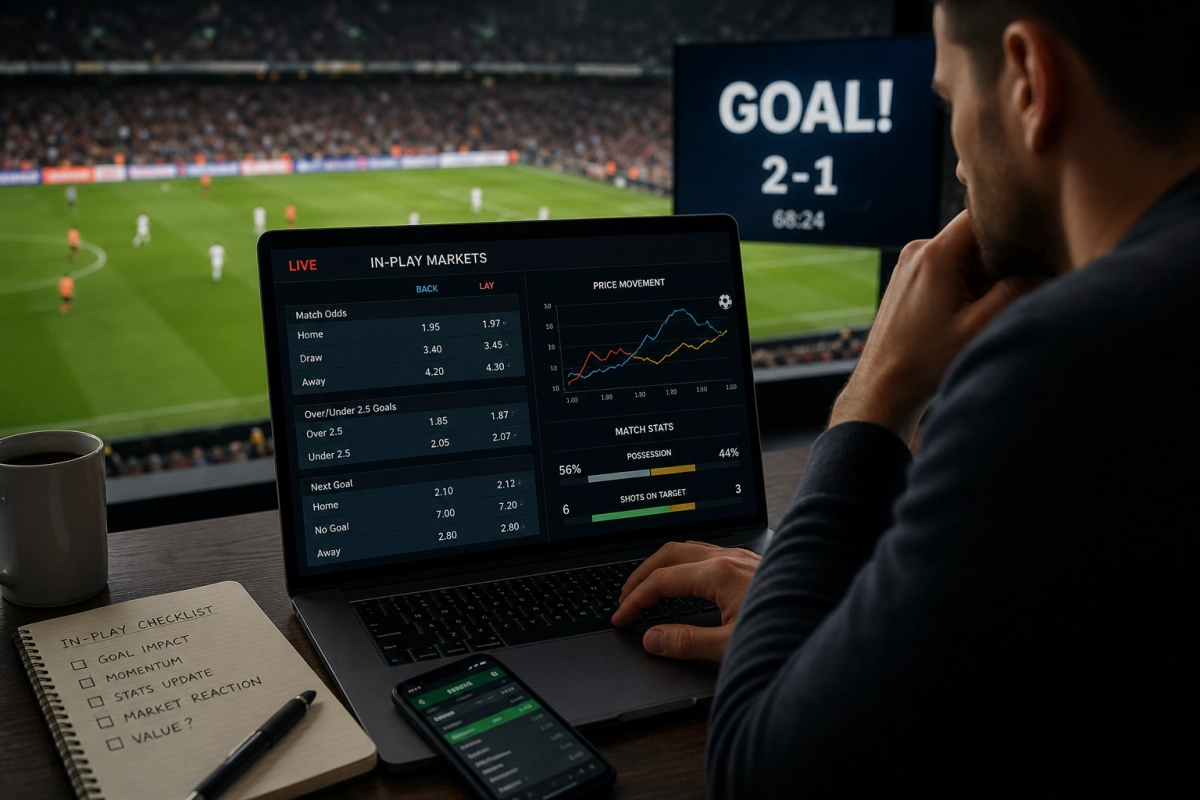
Reading In-Play Football Markets After Major Match Events
Live football betting becomes most demanding immediately after a decisive match event. A goal, red card, injury or tactical change can move live odds within seconds, but the scoreboard rarely tells the complete story. Bettors need to assess what has changed, how each team is responding and whether the available market still reflects the developing match.
In-play markets are betting options available after kick-off, including the match result, next goal, total goals, handicaps, corners and cards. Live odds are continuously adjusted to reflect the score, remaining time, player availability, momentum and expected probabilities. They may also vary between bookmakers, locations and platforms, particularly when markets are suspended after an important incident.
Why Key Events Move Live Football Betting Odds
Bookmakers react to both the event itself and its likely tactical consequences. A goal changes the score and often the risk appetite of the teams. A red card changes the number of players on the pitch and may alter possession, territory and attacking intent. However, the most obvious market is not always the most informative one.
- Goal: The match-result and totals markets usually move quickly. The trailing team may become more aggressive, creating potential relevance for next-goal, corners or total-goals markets.
- Red card: The numerical advantage can influence the result, handicap and team-goal markets. The effect depends on the score, minute, player dismissed and whether the leading team chooses to defend deeply.
- Substitution: A change may improve attacking quality, protect a lead or signal that a player is struggling. The replacement’s position and the team’s new shape matter more than the substitution name alone.
- Injury: An injury to a central defender, goalkeeper or key forward can affect defensive stability or chance creation. If the player remains on the pitch, the impact may be less immediate but still tactically important.
- Formation shift: Moving from a back four to a back three, or adding another striker, can change space, crossing volume and counter-attacking opportunities.
Matching the Event to the Right In-Play Market
A practical approach is to identify the event first, then select a market that measures its likely consequence. The match result is often too broad for a quick reaction, while a more specific market may better reflect the tactical change.
Use the Scoreboard as a Starting Point, Not a Full Analysis
After a goal, bettors can compare the score with the underlying performance. Possession, shots, entries into the penalty area, dangerous attacks and set-piece pressure may indicate whether the goal reflects sustained dominance or an isolated moment. A team leading 1–0 but under constant pressure presents a different live betting situation from a team controlling territory and chances.
After a red card, the score and timing are particularly important. A dismissal in the opening stages gives the stronger side more time to exploit the advantage, while a late red card may have limited influence. The team with fewer players may also change its objective from attacking to protecting a draw or narrow lead.
Check Tactical and Statistical Confirmation
Live statistics should support, rather than replace, visual match analysis. Bettors can monitor whether a substitution changes pressing intensity, whether an injury leaves space on one flank and whether a formation shift creates more corners or shots. Markets such as next goal, handicap, total goals, corners and cards each respond to different match patterns.
Before considering a wager, the bettor should check the current minute, market suspension, price movement, team motivation and available stake. The next part examines a structured process for evaluating these markets without reacting emotionally to sudden odds changes.
Follow a Structured Process Before Placing a Live Bet
Once the market reopens, the first task is to establish a new match baseline. Note the score, minute, player numbers and current formations before assessing the price. This prevents the original pre-match expectation from dominating the decision after the match has materially changed.
- Identify the immediate change: Establish whether the event altered the score, numerical balance, available personnel or tactical shape.
- Assess the response: Look at the next few minutes for evidence of pressure, defensive adjustment, possession changes or a shift in attacking numbers.
- Select the relevant market: Use a result or handicap market for a sustained strength imbalance, totals or next goal for changing attacking intent, and corners or cards when the event is affecting territory or discipline.
- Compare the price with the updated scenario: Ask whether the odds allow enough value for the uncertainty that remains.
This short delay can be useful. Immediately after a goal or dismissal, markets may be suspended, reopened and adjusted several times. Waiting for the teams’ first tactical response may provide more information than attempting to predict the next action from the incident alone. However, delaying also means accepting that the best price may disappear, so the decision should be based on the quality of the information gained rather than a desire to avoid all uncertainty.
Evaluate Prices Rather Than Chasing Sudden Odds Movement
A shortened price does not automatically indicate a good bet. It usually means that the market has assigned a higher probability to an outcome, but that probability may already be fully reflected in the odds. For example, a red card to the weaker team can cause the favourite’s price to contract sharply, even though the favourite may already be ahead and have little reason to attack aggressively.
Bettors should consider what the price implies and whether the match evidence supports it. A team with a numerical advantage may control possession without creating clear chances, while a trailing side with ten players may still threaten through counter-attacks or set pieces. In these situations, team goals, draw-no-bet or alternative handicaps may express the expected pattern more accurately than a heavily priced match-result selection.
It is also important to distinguish between a genuine tactical shift and temporary momentum. A two-minute spell of pressure after conceding does not necessarily justify an immediate next-goal wager. Look for repeated entries into the box, sustained territory, dangerous set pieces or visible defensive disorder before treating the change as meaningful.
Manage Suspension, Liquidity and In-Play Risk
Live markets can be suspended during goals, penalties, injuries and potential red cards. When they reopen, the displayed odds may move again before a bet is accepted. Check the confirmed price, stake limits and settlement terms, particularly for markets involving player participation or abandoned matches.
Execution risk is higher in-play because delays, streaming lags and rapidly changing information can create a different match state between the decision and acceptance. Use only a predetermined stake, avoid chasing a missed price and do not increase exposure simply because an earlier selection has lost. A clear record of the event, reasoning and price can also help evaluate whether future decisions were based on sound analysis rather than emotional reaction.
Make the Next Decision With a Fresh Match View
Successful in-play football betting depends on treating every major event as a reset point rather than an automatic signal. The best decision comes from combining the new scoreline, player numbers, tactical shape, team response and available price. If those factors do not align clearly, preserving the stake is a valid outcome.
Markets will continue to move as the match develops, but opportunities are not obligations. A disciplined bettor waits for sufficient information, chooses a market that fits the likely game state and accepts that uncertainty cannot be removed entirely. This approach keeps attention on decision quality instead of the excitement of reacting first.