
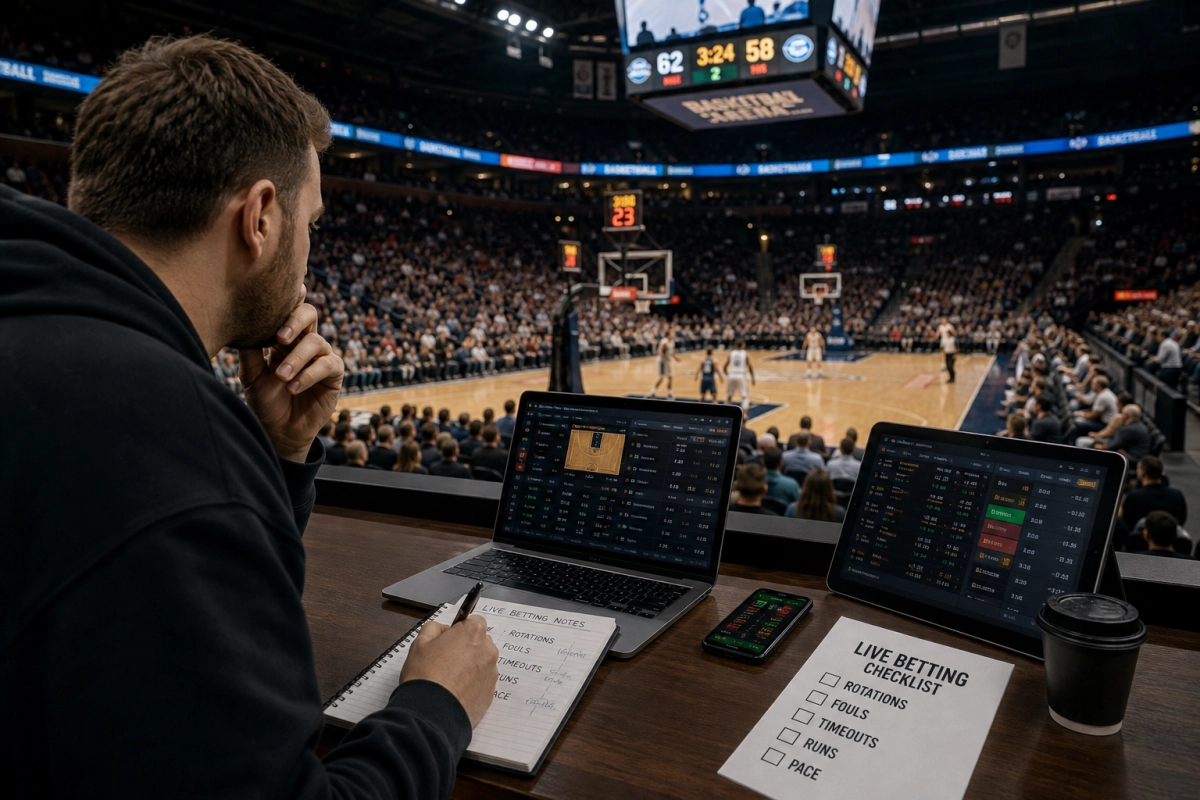
Live basketball betting: read the game, not just the score
Live basketball betting rewards readers who understand how events on court change odds second-by-second. This guide teaches how to interpret coach rotations, player foul trouble, timeouts, scoring runs and pace shifts so bettors can identify short-term in-play opportunities across the NBA, NCAA and Euro leagues. It explains core in-play concepts in plain language, gives practical cues you can use during a match, and emphasises disciplined bankroll rules.
What live basketball betting and in-play markets actually are
Live basketball betting (also called in-play betting) is placing wagers after the match starts. Bookmakers update live odds continuously to reflect the score, remaining time, fouls, substitutions and perceived momentum. Common live markets include:
- Match winner / moneyline (who wins the remainder or the game)
- Handicap (point spread adjusted live)
- Totals (over/under for the game, quarter, or remaining minutes)
- Next score or next player to score (short-term props)
- Player props (points, rebounds, assists within a quarter or game)
- Cash out options (bookmaker offers to settle a bet early)
Important terms: live odds are the prices offered in real time; in-play markets are the available bets; match momentum refers to observable switches in control or scoring tempo; cash out is an optional early exit at a reduced payout. Odds vary between bookmakers and change quickly — be prepared for latency and differences in feeds.
Key basketball cues that move live odds and where to look first
Successful live bettors watch signals, not just the scoreboard. The following cues are the highest-value, repeatable indicators that often create short windows of edge.
- Coach rotations: Track which bench units are on court. Some benches give up pace or defence; others maintain or increase scoring. A sudden extended spell for a high-scoring bench can push totals or quarter lines quickly.
- Player foul trouble: When a primary defender picks up two quick fouls, expect rotations that open scoring opportunities. Watch substitution patterns — if the substitute is a clear scoring downgrade, the opponent’s live handicap may improve.
- Timeout usage: Coaches call timeouts to stop runs or protect players. A timeout early in a run signals tactical reset; failure to call one can signal limited options and continued momentum.
- Scoring runs and momentum: Long runs (8–12+ points) usually move both lines and totals. Identify whether runs are from transition points, set plays, or opponent mistakes — the source matters for sustainability.
- Pace shifts: Teams that speed up create more possessions and inflate totals; tiring teams or those facing foul trouble often slow down, reducing live totals value.
Quick decision templates for fast in-play choices
Use simple templates to decide quickly under pressure:
- If opponent starter has 2 fouls with 6+ minutes left in the quarter and bench MPG < starter MPG, consider a small live hedge on opponent +spread or reduced total for the quarter.
- When a timeout is not called during an opponent’s 10–0 run and the scoring is transition-based, favour short-term over bets (quarter/5-minute totals) rather than full-game bets.
- If rotation shows repeated 7–10 second possessions and efficient shooting, expect higher totals and look for live over in the next 3–6 minutes.
These cues and templates give a practical foundation. The next section will show real-match examples from NBA, college and Euro games and explain how to apply decision templates and bankroll rules in live conditions.
Real-match examples: how the templates play out in live situations
Below are three short, realistic case studies showing how to apply the templates and cues during a match. Each example ends with a fast decision you could make and why.
NBA case — starter in early foul trouble
Score: Home +4, 6:45 left in Q2. Opponent’s primary perimeter defender picks up his second foul on a contested drive. Bench minutes for that opponent are notably lower usage and defensive rating. Cues: foul trouble, sub rotation, and the home team immediately ramps transition attempts.
Template applied: “If opponent starter has 2 fouls with 6+ minutes left and bench MPG < starter MPG, consider a small live hedge on opponent +spread or reduced total for the quarter.” Action: Small live back of the home team’s handicap (e.g., 0.5–1 unit on -2.5 to -4 depending on price) or a quarter total reduction if the book pushes the quarter total higher. Rationale: the opponent’s defensive downgrade increases expected points per possession for the home team for the next 6–8 minutes; the window often closes once fouled player returns or a timeout resets rotations.
College case — uncalled timeout during a run
Score: Underdog trails by 9, 4:10 left in the half. The favorite runs a 12–2 stretch primarily from fast-break layups and opponent turnovers; coach for the trailing team refuses to call timeout. Cues: sustained transition scoring, no timeout, visible bench fatigue.
Template applied: “When a timeout is not called during an opponent’s 10–0 run and the scoring is transition-based, favour short-term over bets.” Action: Take a small live over on the remainder-of-half total or a 5-minute over prop (0.5–1 unit), rather than a full-game bet. Rationale: transition runs create a temporary spike in possessions and efficiency; stopping the clock with a timeout often ends it—absence of a timeout implies higher short-term probability.
Euro league case — pace shift after fouls and substitutions
Score: Away +3, 3:00 left in Q3. Home team’s veteran center leaves with a limp; coach brings in a mobile but offensively limited big. Cues: reduced set-post scoring, quicker perimeter possessions, opponent increases pace to exploit mismatch.
Template applied: “If rotation shows repeated 7–10 second possessions and efficient shooting, expect higher totals.” Action: Back the live game total over for the next 6–8 minutes (1 unit) or a team quarter over. Rationale: smaller lineups and a mobile opposing big increase possessions and open looks—this is a medium-length edge until the injured player returns or a timeout adjusts tactics.
Applying bankroll rules to fast-moving live markets
In-play volatility demands stricter money rules than pre-game bets. Use these compact bankroll principles for every live session:
- Flat live unit: size your live unit at 0.5–1.5% of your bankroll (lower end for beginners). Never exceed 2% on a single live wager.
- Max exposure per game: cap total live exposure to one game at 3–5% of bankroll (sum of all concurrent live bets on that match).
- Stop-loss and profit lock: set a session stop-loss (e.g., 6–8% of bankroll) and an early cash-out profit threshold (e.g., lock in when up 3–4% overall) to prevent tilt.
- Quick sizing rule: when edges are short-term (3–8 minutes), favour smaller stakes; for clearer rotation/foul-driven edges, size toward the higher end of your unit.
These case studies and bankroll rules turn the decision templates into repeatable actions: identify the cue, check rotation/timing, size conservatively, and accept that most in-play edges are short-lived.
Live-session checklist
- Set your live unit and max-exposure limits before tipoff; stick to them even if you see a tempting line.
- Open at least two price feeds so you can compare latency and spot value differences quickly.
- Monitor rotations and immediate foul indicators for the first few minutes — if you miss the cue window, skip the bet.
- Use a simple timer for short-term plays (3–8 minutes) to avoid holding positions past the edge window.
- Record every live wager in a journal with the cue, stake, market, and outcome to build repeatable patterns over time.
- When in doubt, reduce stake size: short-lived edges call for conservative sizing and disciplined exits.
Putting the system to work
Live basketball betting is a skill you develop through repetition, honest record-keeping and restraint. Treat each session as practice: test one template at a time, keep stakes small while you learn the timing, and let the data guide adjustments. Expect variance, protect your bankroll, and prioritise process over short-term results. With disciplined execution and continuous refinement, the cues and templates in this guide can become reliable tools in your live betting toolkit.