
Why live betting is different and why you should care
You already know pre-match betting: you pick a result, stake an amount, and wait for the event to finish. Live betting (also called in-play betting) changes that timeline. Instead of placing all your wagers before kickoff, you can place — adjust — or close bets while the action is unfolding. That makes betting more dynamic, responsive, and potentially more profitable, but it also introduces new risks and psychology you need to manage.
Live betting attracts you because it lets you react to what you see: a key player getting injured, a team suddenly dominating possession, or unexpected weather. The bookie’s odds update to reflect those changes in real time, creating fresh value opportunities if you know how to read the market. At the same time, speed, latency, and emotional decisions can cost you money if you’re unprepared.
Key advantages and dangers to keep in mind
- Advantage — Flexibility: You can hedge pre-match positions, back a comeback, or take short-term markets like next goal.
- Advantage — Live information: Visual cues from the game can reveal value before markets fully adjust.
- Danger — Faster markets: Odds can swing rapidly; delays in your reaction or the app’s feed can lead to missed value or bad fills.
- Danger — Emotional betting: Watching the game live can tempt you into chasing losses or over-betting after a good run.
How in-play odds move and what cash-out actually does
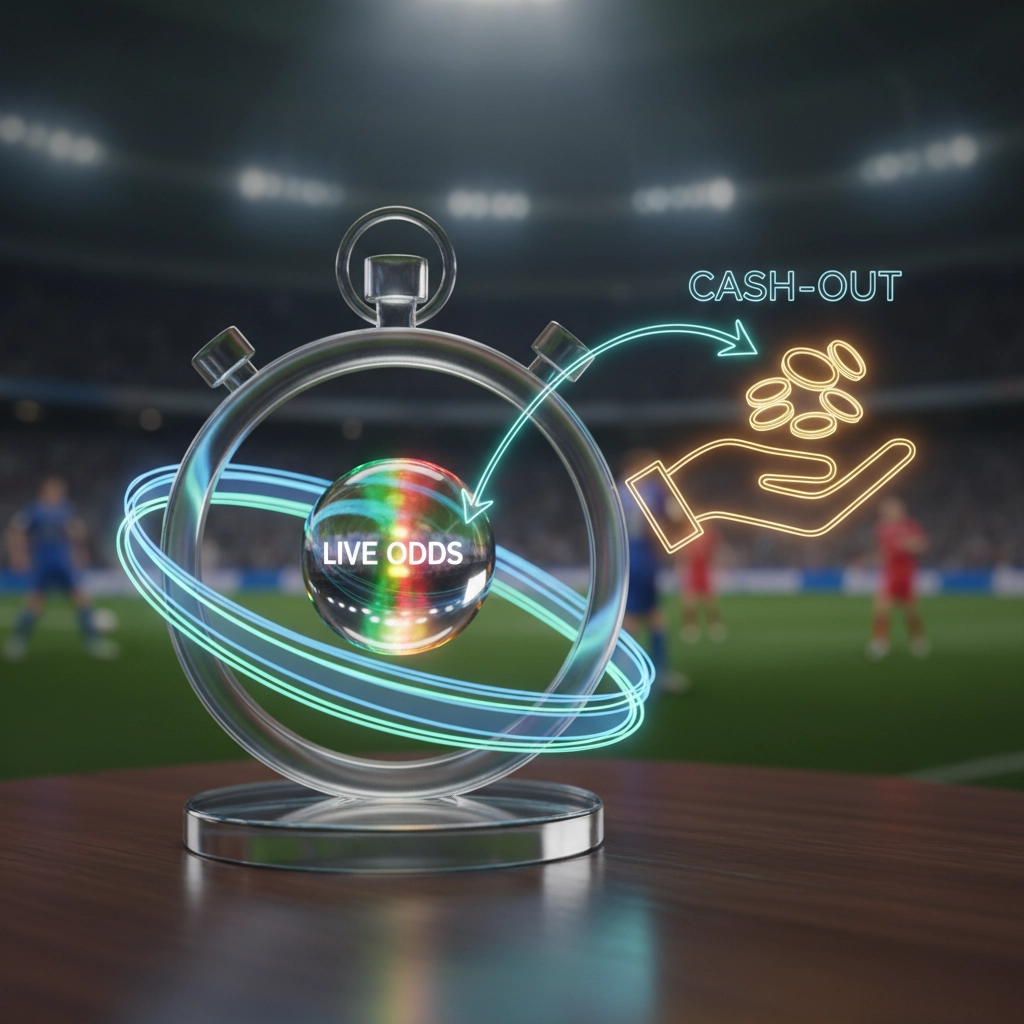
At the heart of live betting are live odds: continuously updated prices that reflect the current probability of an outcome. Bookmakers use algorithms and on-site traders to combine the match state (score, time remaining, possession, bookings) with expected future events. When something significant happens — a goal, red card, or tactical change — the implied probability for outcomes changes, and the odds move accordingly.
Understanding how odds move helps you identify moments of value. For example, if a favored team concedes early but rebounds to control possession, you might find attractive backing opportunities before the market fully responds. Conversely, markets often overreact to short-term fluctuations; spotting those overreactions is a core live-betting skill.
What cash-out is and when you might use it
- Cash-out lets you settle a bet before the event ends for a bookmaker-offered amount. It’s a practical tool to lock profits or cut losses in volatile live markets.
- Use cash-out to protect a lead when the remaining time and match state increase the risk of reversal.
- Be cautious: cash-out prices include a margin and are tilted toward the bookmaker. Treat them as a trade-off, not always the best expected-value option.
Now that you understand the basics of in-play odds and the mechanics of cash-out, the next section will show how to spot value in live markets and apply simple strategies to manage risk and your bankroll.

Spotting value in-play: what to watch and when to act
Value in live markets comes from seeing something the market hasn’t fully priced yet. That requires a short checklist of observable clues and a decision rule — not guessing. Key things to watch:
– Game state signals: possession control, shots on target, territory, set-piece pressure. A team dominating but failing to score often sees its pre-match odds drift; if the match time and expected threat still favor them, that can be value to back.
– Momentum events: a substitution that changes formation, a tactical shift, or a key player returning from injury. These tend to have predictable effects (more attacking or defensive) that markets take a moment to absorb.
– Statistical overlays: count of corners, expected goals (xG) on the live feed, and shot quality. xG spikes or repeated big chances usually precede goals; backing over/unders or next-goal markets around those spikes can work.
– Bookmaker behaviour: watch how quickly different markets move. If the outright market lags while next-goal or match-goal markets move sharply, you may exploit that tempo difference.
When to act: have preset triggers. For example, if Team A has >60% possession and 3+ shots inside the box in a 10-minute window while still losing, consider backing them only if the live price implies less than the probability your criteria assign. A rule-based approach removes emotion and keeps your stakes consistent.
Simple live-betting strategies and bankroll rules you can actually use
You don’t need complex models to be disciplined. Use a handful of practical strategies and strict bankroll rules:
– Flat-percentage staking: risk a fixed small percentage (e.g., 1%) of your bankroll per live bet. That reduces ruin risk when markets swing fast.
– Micro-trading/scalping: take small, short-term positions on tiny odds swings (useful on exchanges) with low stake but frequent trades. Requires quick reactions and strict stop-losses.
– Hedging/partial cash-out rule: if a pre-match bet goes into the lead and cash-out returns 50–70% of the maximal profit you’d accept, take it. Decide this percentage before the match.
– Focused markets: pick 1–2 markets you understand (next goal, Asian lines, corners) and avoid branching into exotic options during play.
Bankroll discipline: set a daily and per-event loss limit, log every trade, and never increase stake size after losses chasing recovery. Live betting magnifies recency bias; your growth comes from steady EV-based decisions, not streaks.
Tools, timing and practical setup for cleaner execution
Execution matters. Improve your edge with the right setup:
– Multiple accounts: open accounts with several bookies to shop for the best in-play prices and avoid single-provider fills that skew EV.
– Low-latency feeds: use bookmakers with fast streaming or integrate third-party live stats. Remember many TV streams lag several seconds — act on data feeds more than your stream.
– Interface practice: rehearse clicking, using hotkeys if allowed, and reading live market depth. Mistakes cost more in live markets.
– Keep it simple: close tabs on one match at a time, have pre-selected staking sizes, and avoid distractions.
Combining clear signals, conservative staking, and tight execution gives you a practical foundation. The next part will build on this with examples, record-keeping templates, and a few advanced tactics for experienced in-play traders.
Practical examples and record-keeping
To turn ideas into repeatable skills, use a simple record and a couple of compact tactics you can test in low-stakes conditions.
- Record template — keep one line per live bet: date, event, market, pre-match stake, live stake, odds taken, cash-out used (yes/no + amount), final result, profit/loss, short notes (signal, timing, misc). Use a spreadsheet so you can filter by market and calculate ROI.
- Tactic — latency awareness: compare two data sources (bookmaker feed + live stats) and time your actions around the fastest feed. If you consistently receive slower fills on one bookie, reduce your stake there for fast-moving markets.
- Advanced tactic — implied-probability scalps: convert live odds to implied probabilities and look for small mismatches across markets (e.g., next goal vs. match winner). Place small, time-limited trades and close when the edge disappears rather than waiting for big swings.
Next steps for steady improvement
Start small, keep records, and iterate: test one market, log every decision, and adapt your rules based on outcomes. Prioritise execution and discipline over clever ideas — the margin you earn comes from consistent application, not heroics. If you find your emotions interfering, pause and revisit your staking plan. For help with safer play and limits, see responsible gambling resources.
Frequently Asked Questions
Is live betting better value than pre-match betting?
It depends. Live betting can offer value when you spot information the market hasn’t fully priced (momentum shifts, tactical changes). However, markets move faster and prices include a margin; consistent value requires discipline, fast execution, and selective market choice.
How do I avoid losses caused by stream or data delays?
Use the fastest available data feed (bookmaker streaming or dedicated live stats) rather than TV streams, keep multiple provider accounts to shop for prices, and reduce stakes on markets that require ultra-fast reactions. Practise to learn the typical latency of your setup.
When should I use cash-out during live betting?
Use cash-out as a risk-management tool: to lock acceptable profits when the remaining time or match state increases reversal risk, or to cut losses when your original thesis is clearly invalid. Treat cash-out offers as a trade-off — compare the offered amount to the expected value before accepting.