
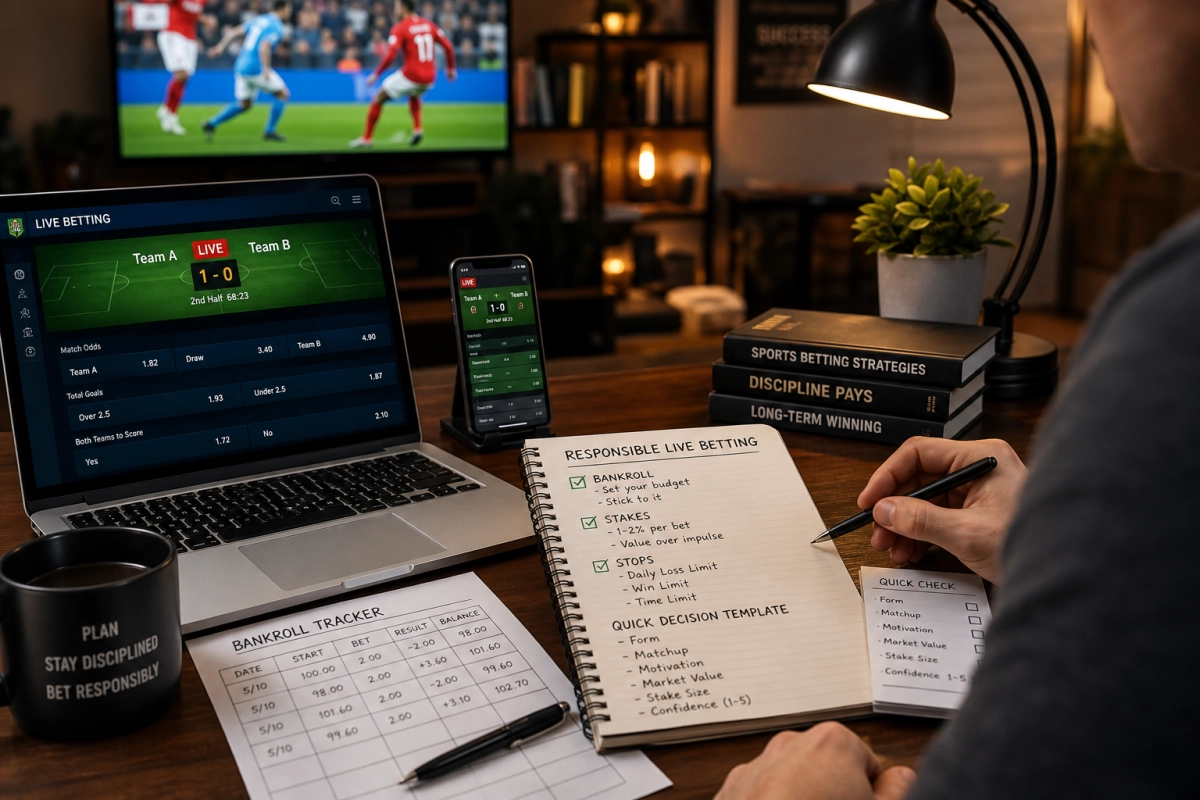
Responsible live betting: core rules and fast templates for disciplined in-play wagering
Why a rules-first approach matters in live betting
Live betting (also called in-play betting) moves faster than pre-match markets. Odds update continuously as events — goals, turnovers, serve breaks, substitutions, fouls — change the probability of outcomes. Responsible live betting requires pre-set rules so split-second choices remain rational rather than emotional.
Before discussing sport-specific tactics, readers need clear definitions and a compact set of rules they can apply across football, basketball and tennis. Below are essential concepts and why they matter for real-time decisions.
Essential live betting terms explained
- Live odds — bookmaker prices that change during a match based on events and market flow.
- In-play markets — examples: match winner, next goal/point, totals (over/under), handicap, next scorer, next set.
- Cash out — an option to settle a live bet early for a reduced/expanded amount before the final outcome.
- Match momentum — the recent pattern of play (scoring runs, possession, service pressure) that shifts probabilities faster than the clock.
- Live statistics — real-time data (possession %, shots, corners, serve speed, break points) used to gauge momentum and value.
Core bankroll rules and stake-sizing frameworks for responsible live betting
Start with a dedicated live-bankroll separate from any pre-match or recreational fund. That reduces pressure to “chase” losses and makes rules easier to follow.
Practical bankroll rules (apply before every session)
- Set a session bankroll: the maximum amount available for a single day or match session.
- Define max single-bet exposure: commonly 1–3% of the live-bankroll per wager for most bettors.
- Set a stop-loss for the session: e.g., 5–10% of the bankroll. If reached, stop betting for that session.
- Declare a take-profit target: a preset gain (for example +10%) that triggers pausing or reducing risk-taking.
Stake-sizing frameworks (choose one to use consistently)
- Flat-percentage method: bet a fixed % (1–3%) of current live-bankroll. Simple and safe.
- Unit system: assign a unit value; bet 1–3 units depending on confidence and market volatility.
- Fractional Kelly: use a reduced Kelly fraction (e.g., 10–25% of full Kelly) for growth-aware bettors; requires edge estimation and is more advanced.
- Market-adjusted sizing: reduce stake on high-volatility markets (next goal/point) and increase slightly on lower-volatility (handicap or match-winner late in game).
Quick decision template for live moments
- 1. Check clock and score — how much time/value remains?
- 2. Read momentum — which team/player controls possession or pressure?
- 3. Inspect live stats — are shots, corners, or break points supporting the momentum read?
- 4. Apply rules — does the stake fit the bankroll cap and stop-loss limits?
- 5. Emotional check — pause for 10 seconds if uncertainty or tilt is present.
- 6. Execute or pass — place the pre-sized stake or skip; don’t increase size to chase.
These core rules create a disciplined baseline. The next section will apply these bankroll and stake-sizing frameworks to practical scenarios in football, basketball and tennis, with sport-specific stop-loss/take-profit triggers and quick templates for common live markets.
Football — momentum cues, timing rules and market-specific stakes
Football in-play is often about low-frequency, high-impact events (goals, red cards, penalties). That changes how you size stakes and set stop triggers.
- Stake-sizing by market: next goal/first goal markets are high-volatility — reduce to 0.5–1% of live-bankroll. Match-winner or handicap late in the game (after 70′) can be sized at 1.5–2% if your read is strong and cash-out options exist.
- Sport-specific stop-loss/take-profit triggers: immediate stop for that match if a red card for your backed side or if two goals are conceded inside a 10-minute span. Session stop-loss still applies (e.g., 5–10% of live-bankroll); declare a take-profit (for example +10%) and shift to neutral or flat 0.5% bets once reached.
- Cash-out playbook: consider cashing out to lock >50% of unrealised profit when momentum clearly reverses (opponent forcing multiple corners/shots and possession >65%). Avoid cashing out to limit small losses unless your match-read confidence is <25%.
Quick football decision template (10–20 seconds)
- Clock/score check: how much time left and what score dynamics matter?
- Read momentum: corners, shots on target, substitution for attacking intent?
- Key stat check: xG since last 10 minutes, possession, set pieces count.
- Rule check: does this fit your market volatility rule and stake cap (0.5–2%)?
- Emotion check: 10-second pause if tilt or revenge-chasing present.
- Action: place pre-sized bet or step away; set an exit (cash-out threshold or red-card stop).
Basketball — run management, timeout effects and quick-turn markets
Basketball is high-frequency scoring. Momentum swings fast; timeouts and fouls are high-value cues. Use slightly larger base stakes on lower-volatility options and sharply reduce on “next play” markets.
- Stake-sizing by market: next 5-minute total or quarter spread: 1–2% of live-bankroll. Next possession/moneyline: 0.5–1%.
- Stop-loss/take-profit rules: stop for a match if you hit three consecutive losing live bets or lose 6–8% of session bankroll. If the team you back has two starters with foul trouble (≥3 personal fouls) and bench weakness, reduce or pause betting on that game.
- Timeout and lineup rule: if opponent calls timeout after a scoring run, reduce stake on immediate next-market as coaches often change strategy — market volatility increases.
Quick basketball decision template
- Check score/clock and recent run (+/- last 5 minutes).
- Scan fouls, timeouts remaining, substitution patterns.
- Inspect live stats: turnovers, offensive rebounds, pace (possessions/min).
- Apply stake rule and session stop; pause 10 seconds if uncertain.
- Place pre-sized stake or skip; predefine cash-out at a set profit % to avoid giving back gains during runs.
Tennis — serve dominance, breakpoint windows and micro-stakes
Tennis is a point-by-point sport where a single serve or break swing can change markets instantly. That requires micro-stakes and sharp statistical reads.
- Stake-sizing by market: next point/game: 0.25–1% of live-bankroll. Set/match-winner when a break is likely (multiple breakpoints created): 1–1.5%.
- Stop-loss/take-profit rules: if a player loses serve and immediately faces a string of double faults or medical timeout, freeze that match for the session. Stop betting on that match after three quick losses or if session drawdown >5%.
- Serve/return read: prioritize first-serve % and return points won over general momentum; a player winning >60% of return points in a service game is a high-value signal to size up slightly (within your market cap).
Quick tennis decision template
- Check server, game score and pressure points (breakpoint, set point).
- Scan stats: first-serve %, double faults, return points won, recent game durations.
- Apply stake cap (0.25–1%) and session limits; pause if medical timeout or visible injury.
- Execute or pass; set an exit rule (cash-out or hedge) when you can lock >40–60% of unrealised profit without violating bankroll discipline.
Turning rules into routine
Responsible live betting is less about finding a magic edge and more about consistently applying clear rules under pressure. Make the rules automatic, keep stakes modest while you learn, and treat each session as practice for better decision-making rather than a quick path to wins.
Practical session checklist
- Set and lock a session bankroll before the first live market.
- Choose one stake-sizing method and calculate unit sizes in advance.
- Declare stop-loss and take-profit thresholds and commit to them.
- Limit which in-play markets are allowed for the session (avoid high-volatility “next” markets unless pre-sized).
- Use a 10-second emotional check before every live wager; skip if uncertain.
- Define cash-out/hedge triggers for unrealised profit protection.
- Record every live bet with outcome, stake, rationale and emotional state.
- End the session immediately if the stop-loss is hit or the take-profit target is reached.
Sustaining discipline and improving over time
- Review your bet log regularly to identify recurring mistakes and adjustments needed.
- Measure simple metrics (win-rate, average return per unit, largest drawdown) and refine stake-sizing conservatively.
- Test changes with micro-stakes before increasing exposure.
- Withdraw a portion of realized profits to separate them from your working bankroll.
- Enforce breaks after tilt or emotional sessions; reset rules before returning.
- Prioritize process over short-term outcomes—consistency compounds more reliably than sporadic risk-taking.
Make these practices habitual and treat discipline as the primary skill you develop. Over time, a rules-first approach will make your in-play decisions clearer, quicker and less driven by emotion.
Tools, latency and smart automation for cleaner live decisions
Beyond rules and templates, the right tools and interface habits reduce noise and help you execute live decisions reliably. Technology can amplify discipline when used correctly, but it can also magnify mistakes if attention or connectivity is poor.
Bookmaker selection and line-shopping
- Maintain multiple accounts across reputable bookmakers and at least one exchange to compare prices instantly; small price improvements compound over time.
- Prefer providers with transparent in-play liquidity and a reliable cash-out feature; avoid books that consistently delay prices or freeze markets after key events.
- Know account limits and settlement policies—some operators restrict live stakes or void markets in unusual situations, which affects your risk management.
Latency, interfaces and data feeds
- Use a stable, low-latency internet connection and prioritize desktop or a dedicated tablet when doing serious live work; mobile apps can be fine for small micro-stakes but often introduce delay.
- Monitor two sources: the bookmaker feed (for odds) and an independent live-stat feed (for possession, xG, serve speed). Discrepancies signal stale information or feed lag.
- Keep refresh and auto-update settings sensible; rapid full-page reloads can cause accidental misstakes—use focused panels and clearly labeled bet-slip templates.
Alerts, calculators and cautious automation
Set automated alerts for specific triggers (score change, red card, breakpoint) so you don’t react purely to emotion. Use a stake calculator or pre-programmed unit buttons to eliminate on-the-fly sizing errors. If you test partial automation (API orders, conditional cash-outs), do so at micro-stakes and respect bookmaker terms—automation should support a rules-first process, not replace your judgment.
Used responsibly, tools make it easier to keep rules intact under pressure: they remove manual friction, highlight real signal vs noise, and help you enforce the stop-loss and take-profit boundaries you set before kickoff.