
Seizing momentum: read the flow before you place in-play bets
You win more often live when you can recognize momentum shifts faster than the market. Momentum isn’t a mystical force — it’s a set of observable events that change probability in real time. When you watch a match, focus on the events that indicate increasing attacking intent, defensive frailty, or tactical drift. Those are your signals to look for short-term opportunities.
- Shot volume and quality: Multiple shots or dangerous attempts inside the box in a short span usually precede a goal. Track not just attempts but where they’re taken from.
- Territory and possession intensity: A team pinned in its own half, repeatedly forced into clearances, is under momentum pressure even if they still have the ball occasionally.
- Set-piece frequency: Repeated corners and free-kicks in the same half increase expected goals (xG) and often signal a tangible momentum advantage.
- Substitution patterns: Defensive subs after conceding or attacking subs when a team presses show intent to change the game’s dynamic.
In live markets, odds adjust quickly but not instantly to these signals. You should develop a short checklist you run mentally every few minutes: who is pressing, where are chances coming from, and did a tactical change just happen? Use micro-markets like next-goal, next-corner, or 10-minute goal lines to exploit clear momentum runs rather than trying to predict full-match outcomes mid-game.
Assessing injuries and substitutions quickly and accurately
Injuries are low-probability events that cause large odds moves. Your advantage comes from assessing impact faster than the betting exchange. When a player goes down, don’t react to the event alone — estimate functional impact:
- Who was affected? A full-back replaced by a like-for-like sub is less disruptive than a central midfielder or a lone striker going off.
- Timing matters: An early injury forces tactical changes and often increases volatility; a late-game knock is less likely to alter market expectations.
- Substitute quality: Evaluate whether the incoming player is a defensive shield or an attacking spark. Promoted youngsters or exhausted veterans can change expected output.
- Psychological effect: Momentum can swing if the injured player is a team leader; watch teammates’ body language and immediate tactical reshuffles.
Practical steps: pause briefly to update your mental model, then choose a market aligned with the new state — for example, if a lead team loses a center-back, look at increased odds for late goals or favor the opponent in corner markets. Always factor in the bookmaker’s reaction time and potential delays in in-play price adjustment.
How yellow and red cards change the live betting landscape
Cards are compact signals with outsized influence. A single yellow can restrain an aggressive full-back; a red card usually forces a team to reorganize and alters probabilities dramatically. Learn the tactical consequences so you react with suitable market selections rather than emotion.
- Yellow cards: Key attackers on a booking may stop forward runs, reducing immediate goal threat. Consider under markets or reduced stakes on attacking outcomes.
- Red cards: Numerical disadvantage typically increases opponent possession, shots, and set-piece opportunities. Markets to watch include next-goal, total goals over a short period, and corners.
- Accumulation risk: Teams with poor discipline late in matches often concede from free-kicks; keep an eye on teams prone to multiple cards.
In the next section you’ll learn how to combine these live reads into concrete staking strategies, choose the best markets for different scenarios, and manage risk while reacting to odds swings.
Staking strategies that match the live scenario
In-play staking shouldn’t mirror your pre-match routine. Live markets are higher-volatility and shorter-duration — treat stakes accordingly. Build a simple, rules-based staking plan you can apply without thinking under pressure.
- Base stake as percentage of bankroll: Use a small live unit (0.5–2% of bankroll) as your baseline. Increase or decrease from that base depending on conviction and scenario severity.
- Scenario multipliers: Create fast-reference multipliers: e.g., momentum surge = 1×–1.5× base, clear tactical injury or red card early = 1.5×–3× base, last-minute speculative counters = 0.25×–0.5× base. This keeps aggression proportional to signal strength.
- Scale in and out: Rather than one all-in bet, layer entries: place a partial stake when a momentum run begins and add if the trend continues. Likewise, consider taking partial cashouts to lock profits while leaving a free piece to run.
- Market-specific sizing: Micro-markets (next-goal, next-corner) deserve smaller stakes than match-winner or Asian line adjustments because they’re binary and swingy. Size micro bets at 25–50% of your base live unit.
- Value threshold: Only deploy upgraded stakes when live odds imply a probability at least 15–25% worse than your updated estimate. That gap justifies risking extra capital in the volatile in-play environment.
Picking the right market for each event
Choosing the correct market is as important as recognizing an event. Match the market’s time horizon and payout profile to the change you observed.
- Momentum runs: Use short lenses — next-goal, 10-minute goal lines, and next-corner. These capture bursts of pressure without tying up capital for the full match.
- Red cards or major tactical shifts: Look at opponent next-goal, Asian handicaps, or total goals for the remainder of the match. If a team goes down to ten early, the opposing team’s Asian -0.5 line often becomes value.
- Key injuries: For attacks disrupted by a striker loss, consider match-winner hedges, cashout to preserve profit, or under-goals markets; for defensive losses, target opponent goal markets and corners.
- Low-liquidity traps: Avoid obscure props with thin liquidity that create wide, stale odds. Stick to markets that adjust quickly and have depth on the exchange so you can enter and exit reliably.
Risk controls, exit rules and limiting emotional mistakes
Discipline differentiates profitable live bettors from casual punters. Have pre-set limits and simple exit rules you can apply mid-match.
- Max exposure: Cap any single live position to a fixed percentage of bankroll (suggested 3–5%). Never let a cascade of live bets collectively exceed a pre-defined exposure limit.
- Stop-loss and profit-taking: Set a mental or platform-triggered stop-loss for sessions (e.g., 5–8% loss) and a profit target to withdraw risk (e.g., after 3–5% gain). Walk away or reduce size after either hits.
- Hedging rules: If a position goes against you, prefer partial hedges to full reversals; take smaller counter-bets to reduce downside while keeping a chance to recover.
- Behavioral guardrails: Limit consecutive in-play bets (for example, no more than 6 per match) and force a cooling-off after three losing trades to prevent tilt.
Putting it together: practice, patience, process
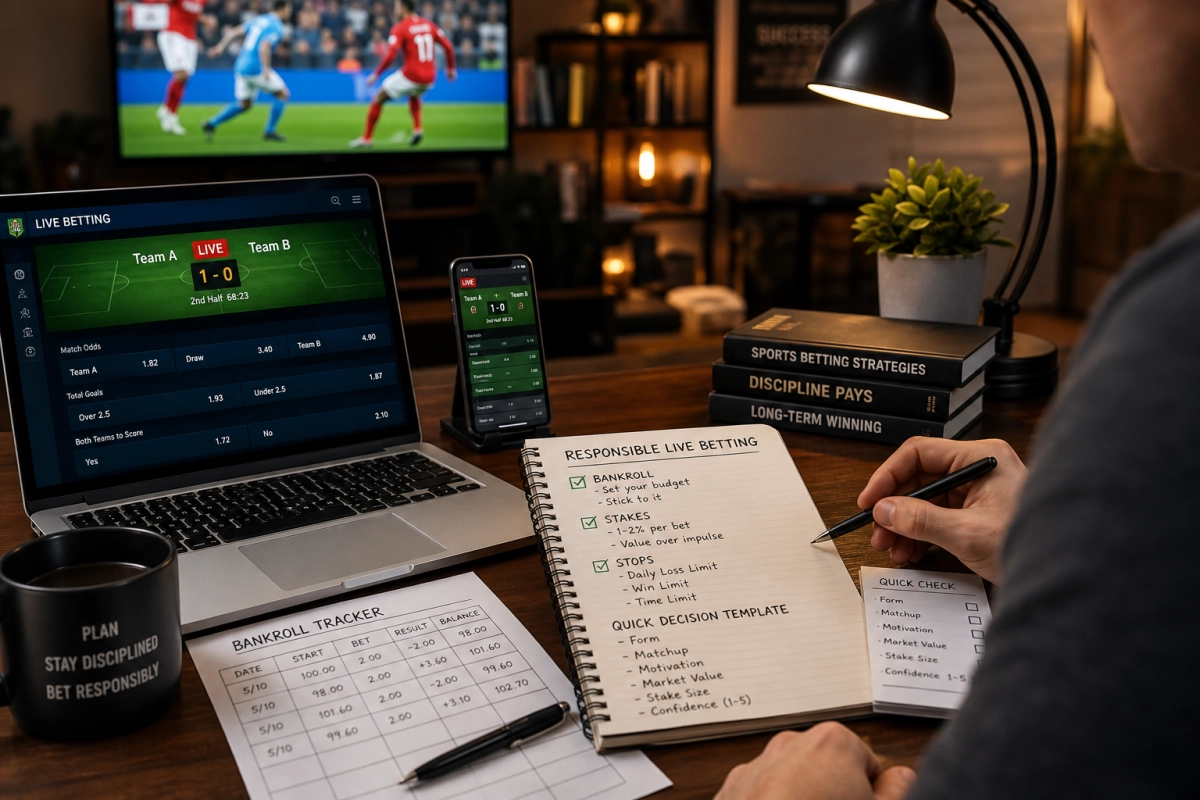
Live betting rewards those who treat it like a discipline rather than a thrill. Keep sized experiments, record outcomes, and iterate on the simple rules that work for you. Prioritize reliable live data and a calm decision process over gut reactions — small, repeatable advantages compound. If you want a reliable source for live match stats to sharpen your reads, try live match stats.
Frequently Asked Questions
How quickly should I react to a red card or a significant injury?
React fast enough to capture favorable odds but not so fast that you act on noise. Pause a few seconds to confirm the call, note the timing and tactical implications, then apply a pre-defined staking rule (e.g., 1.5×–3× base for major early-game events). Use short-horizon markets (next-goal, remainder match totals, Asian lines) to express the change without overcommitting.
Can live betting be more profitable than pre-match betting?
It can be, because live markets allow you to exploit transient information (momentum, injuries, cards) that the pre-match market didn’t price. However, it also brings higher variance and faster decision-making. Profitability depends on data quality, disciplined staking, risk controls, and your ability to read and act faster than the market.
What tools should I have open when placing in-play bets?
At minimum: a high-quality live broadcast, a reliable live stats feed (shots, xG, corners), and a betting exchange or bookmaker with deep liquidity. Add a simple tracker for your live stakes and rules (max exposure, stop-loss, session limits). These reduce latency, improve decision accuracy, and help you manage risk under pressure.