
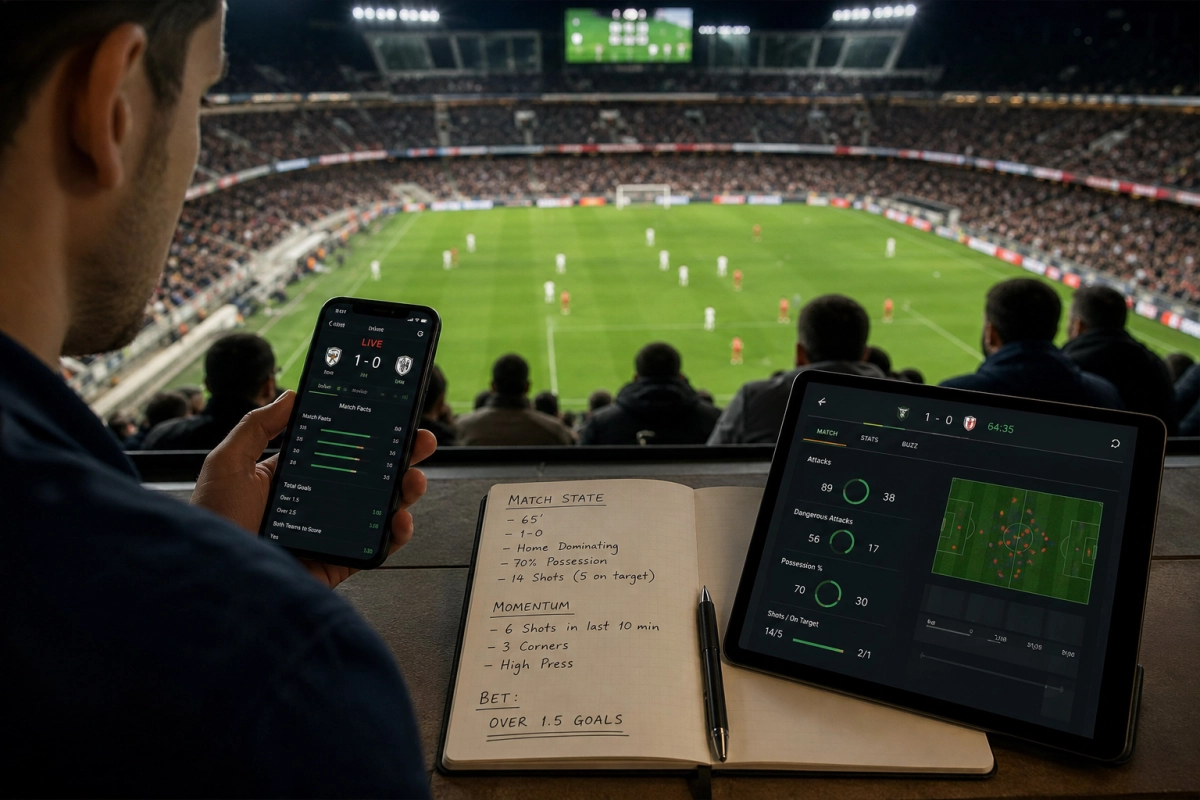
Live score betting: why match state, momentum and in-play stats matter
Live score betting offers a different challenge to pre-match markets: odds move continuously as the match unfolds and the actionable edge is often about timing, not prediction. This piece explains the core concepts of in-play betting, how live odds respond to match-state events, and the live statistics bettors should watch to identify value while controlling risk.
Core concepts and common in-play markets every bettor should know
Before placing live bets, a clear glossary of terms and markets helps avoid confusion. Below are concise definitions and why they matter for timing decisions.
Quick glossary of live betting terms
- Live odds: bookmaker prices that change during a match to reflect new information (goals, injuries, time left, etc.).
- In-play markets: markets available during the match — common examples: next goal, next point, handicap, totals (over/under), correct score and period/quarter bets.
- Cash out: an offered price to settle an open bet before its natural end; reflects current probabilities and the bookmaker’s risk.
- Match momentum: the flow of play — sustained attacking pressure, scoring runs or tactical shifts that make particular outcomes more or less likely.
- Live statistics: real-time metrics such as possession, shots on target, expected goals (xG), rebounds, rotations, serve percentage and break point conversion — used to judge how likely an event is.
How match state and live stats guide timing, with sport-specific triggers
Good live betting relies on interpreting how events change probabilities. Instead of reacting to the score alone, bettors should combine the time remaining, momentum signals and market drift to find value.
General timing rules
- Shorten time horizon: markets with a short time window (next goal, next point, next basket) require faster reads; larger markets (match winner, total goals) allow more time to judge trends.
- Prefer markets with clear triggers: odds often overreact to goals or big plays — watch how the market settles after the initial move.
- Use live stats as checks, not confirmations: a single shot on target doesn’t equal dominance; sustained xG or possession advantage is a stronger signal.
Sport-specific examples to visualise timing
- Football: If a team leads 1–0 at 75 minutes but concedes possession, a defensive substitution by the leader and strong away xG progression, the odds for an equaliser may still be generous — look for next-goal or late totals opportunities but size stakes conservatively.
- Basketball: A 12–0 run after a timeout indicates hot form and rotation advantages; quarter markets and live handicaps adjust quickly — favour bets after the first 2–3 minutes of a run when substitution patterns stabilise.
- Tennis: A player breaks serve and leads 5–3; watch serve percentage and unforced errors. If the opponent is visibly fatigued, the market for the next set shifts fast — consider next-game or set bets rather than match outright.
Risk management remains essential: set bankroll limits, fix stakes relative to a live bankroll percentage, avoid chasing losses and pre-set exit rules for cashing out or hedging. Live odds change continuously and can vary between bookmakers; always confirm prices before placing a bet.
Next, the guide will dive into sport-by-sport tactical checks, live-stat indicators and example workflows for spotting high-probability in-play bets in football, basketball and tennis.
Football: tactical checks, live-stat triggers and a simple workflow
Live football bets work best when you track how the tactical picture shifts after an event (goal, card, substitution). Prioritise sustained signals over single incidents — miners’ pickaxe swings that create consistent xG pressure or clear structural changes.
- High-value live stats: rolling xG (last 10–15 minutes), shots on target, big chances, touches in the box, corners and PPDA (pressing intensity).
- Tactical red flags and triggers: late attacking substitutions, a top scorer remaining on while the opponent brings on defensive midfielders, increasing crosses/long balls from a trailing side, or a team switching from man-marking to a compact block.
- Markets to prefer: next goal/next team to score, over/under 0.5/1.5 (late), correct half scores, small handicap lines — avoid match-winner markets in volatile late-game periods unless you have clear structural advantage.
Example workflow (75th minute, 1–0):
- Check last 15’ xG — if the trailing team’s xG trend is consistently rising, flag next-goal and late over 0.5 markets.
- Confirm substitutions and set-piece frequency — an attacking sub plus three corners in five minutes strengthens a next-goal case.
- Compare live prices across 2–3 bookmakers; if odds imply a lower probability than the trend suggests, size a conservative stake (e.g., 1–2% of live bankroll) because time remaining is short.
- Plan an exit: cash out threshold or hedge with a small opposite bet if an immediate counterattack occurs or the leader changes to ultra-defensive structure.
Basketball: rotation, run dynamics and which in-play stats predict continuation
Basketball is fast and granular — the best signals are substitutions, line-up continuity and efficiency differentials over short intervals. Markets move rapidly, so be deliberate about waiting for stabilised line-ups.
- High-value live stats: offensive rating per possession in the last 3–6 minutes, rebound differential, turnover rate, free-throw rate, three-point attempts and makes, plus/minus for line-ups.
- Triggers to act on: a team goes on a 10+ point run with starters staying on after timeout; a key defender sits with foul trouble; sudden spike in opponent turnovers leading to transition points.
- Markets to prefer: live handicaps, quarter/period markets, next score or next player to score (when rotation is stable), player prop markets tied to minutes (free throws, threes).
Example workflow (mid-quarter run):
- Wait 90–120 seconds after a run begins to ensure the rotation hasn’t changed; watch whether the offending team keeps the hot line-up.
- If offensive efficiency stays high and defensive rebounding is suppressed, back the run continuation on quarter markets or an adjusted handicap.
- Size stakes proportionally to time remaining in the quarter and volatility of the line-up; reduce size when heavy bench substitutions occur.
Tennis: serve metrics, break-point context and timing set/game bets
Tennis is about small, high-frequency edges: one break swing can flip a set. Focus on serve quality and return success in the most recent service games rather than whole-match aggregates.
- High-value live stats: first-serve percentage, first-serve points won, return points won, double faults, winners-to-unforced-error ratio, break-point conversion/creation.
- Triggers to act on: a server’s first-serve % drops sharply across consecutive service games, an opponent converts multiple break points, visible fatigue or footwork degradation late in long rallies.
- Markets to prefer: next-game, next-set, total games (especially when trend shows server weakening), and live correct score in sets.
Example workflow (end of set, player serving 4–5% drop in first-serve):
- Check return points won and break chances in the last two service games — if returner has consistently won higher % on second serves, value often exists on a break/next-game bet.
- Confirm momentum: look for rising unforced errors and shorter winners; if the server is under pressure, back the opponent at a profitable price for the next game or set.
- Keep stake sizes conservative when betting several games ahead; use game-by-game hedges if the match swings back.
Practical live-betting routine
- Set a live-bankroll and fixed stake rules before the event; decide maximum percent per in-play bet and a session loss cap.
- Open the match feed and one or two stat sources; mute audio distractions and focus on a single market type (next goal, quarter, next game) per match.
- Observe the first meaningful period (10–15 minutes in football, one quarter in basketball, first two service games in tennis) to understand tempo and rotations before committing money.
- Wait 60–120 seconds after a major event (goal, timeout, break of serve) to let the market settle and confirm substitutions/line-up continuity.
- Cross-check prices across bookmakers quickly; if the implied probability differs meaningfully from your live read, size stakes conservatively and avoid large commitments immediately.
- Use predefined exit rules: set cash-out thresholds, hedge triggers or fixed profit/loss limits to prevent chasing and emotional decisions.
- Log every in-play bet with context (time, score, market, live stats seen, stake, result) and review weekly to refine rules and spot recurring edges or mistakes.
Putting discipline and iteration at the centre
Success in live-score betting is less about predicting every outcome and more about disciplined execution: keeping to rules, managing size and learning from each session. Treat in-play markets as fast information systems — they reward repeatable processes, quick but cautious decision-making, and continuous feedback from your own records.
Final behavioral reminders
- Start small: use reduced stakes or paper trading while you internalise timing and stat interpretation.
- Prioritise process over short-term P&L; small, consistent edges compound if managed responsibly.
- Avoid overspeculation after swings; take breaks and stick to your session limits to protect bankroll and judgement.
- Iterate: adapt rules for each sport and market as you gather more live-data experience; what works for basketball quick runs won’t transfer verbatim to tennis or football.
Keep the approach pragmatic, review outcomes with an objective eye, and let disciplined routines — not impulses — guide your live-betting decisions.